






Diese Website verwendet Cookies und ähnliche Technologien. Dabei handelt es sich um kleine Textdateien, die auf eurem Computer gespeichert und ausgelesen werden. Indem ihr auf "Alles akzeptieren" klickt, stimmt ihr der Verarbeitung von Daten, der Erstellung und Verarbeitung von individuellen Nutzungsprofilen über Websites und über Partner und Geräte hinweg sowie der Übermittlung eurer Daten an Drittanbieter zu, die eure Daten teilweise in Ländern außerhalb der Europäischen Union verarbeiten (GDPR Art. 49). Einzelheiten hierzu findet ihr in den Datenschutzhinweisen. Die Daten werden für Analysen und für eigene Zwecke Dritter verwendet. Weitere Informationen, auch über die Datenverarbeitung durch Drittanbieter und die Möglichkeit des Widerrufs, findet ihr in den Einstellungen und in unseren Datenschutzhinweisen. Hier könnt ihr mit den notwendigen Tools fortfahren.
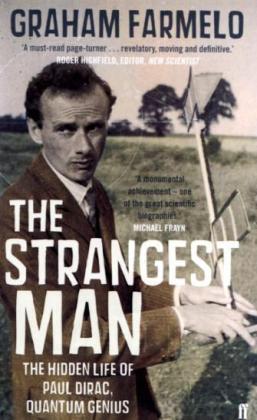
- Verlag: Faber & Faber, London
- Autor: Graham Farmelo
- Artikel-Nr.: KNV22546024
- ISBN: 9780571222865
'A monumental achievement - one of the great scientific biographies.' Michael Frayn
The Strangest Man is the Costa Biography Award-winning account of Paul Dirac, the famous physicist sometimes called the British Einstein. He was one of the leading pioneers of the greatest revolution in twentieth-century science: quantum mechanics. The youngest theoretician ever to win the Nobel Prize for Physics, he was also pathologically reticent, strangely literal-minded and legendarily unable to communicate or empathize. Through his greatest period of productivity, his postcards home contained only remarks about the weather.
Based on a previously undiscovered archive of family papers, Graham Farmelo celebrates Dirac's massive scientific achievement while drawing a compassionate portrait of his life and work. Farmelo shows a man who, while hopelessly socially inept, could manage to love and sustain close friendship.
The Strangest Man is an extraordinary and moving human story, as well as a study of one of the most exciting times in scientific history.
'A wonderful book . . . Moving, sometimes comic, sometimes infinitely sad, and goes to the roots of what we mean by truth in science.' Lord Waldegrave, Daily Telegraph