






Diese Website verwendet Cookies und ähnliche Technologien. Dabei handelt es sich um kleine Textdateien, die auf eurem Computer gespeichert und ausgelesen werden. Indem ihr auf "Alles akzeptieren" klickt, stimmt ihr der Verarbeitung von Daten, der Erstellung und Verarbeitung von individuellen Nutzungsprofilen über Websites und über Partner und Geräte hinweg sowie der Übermittlung eurer Daten an Drittanbieter zu, die eure Daten teilweise in Ländern außerhalb der Europäischen Union verarbeiten (GDPR Art. 49). Einzelheiten hierzu findet ihr in den Datenschutzhinweisen. Die Daten werden für Analysen und für eigene Zwecke Dritter verwendet. Weitere Informationen, auch über die Datenverarbeitung durch Drittanbieter und die Möglichkeit des Widerrufs, findet ihr in den Einstellungen und in unseren Datenschutzhinweisen. Hier könnt ihr mit den notwendigen Tools fortfahren.
- Verlag: Ernst & Sohn
- Autor: Sergej G. Fedorov
- Artikel-Nr.: KNV70001204
- ISBN: 9783433031568
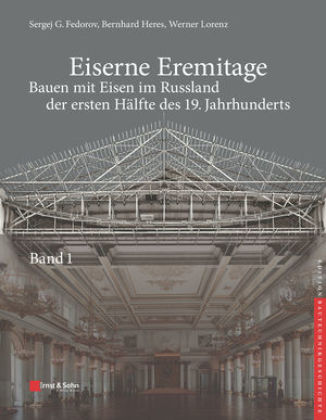
Constructed in an era that was open to new technologies, when Europe was beginning to explore the possibilities of building with iron and to formulate initial rules and codes of practice, the iron structures concealed behind the facades and suspended ceilings of the Hermitage provide a unique testimony to the early days of European steel construction.
The fruits of a research project spanning several years, this two-volume monograph sheds remarkable new light on this world-class building complex: never before has a historic iron construction been captured, documented and interpreted in such breadth and depth as this. The study illustrates what a building research project with a strong engineering focus can achieve when it combines an evaluation of extensive archive collections and in situ investigations with laboratory and structural analyses, while at the same time placing them expertly within a contemporary and historical construction context. One volume of plates consists of archive documents, detailed architectural drawings and visualisations of the iron support structures selected from the wealth of material, complete with commentary.
When researching the history of iron construction and design and seeking further explanations, the authors traced the iron's long journey back to its roots in the iron ore mines and smelting furnaces of the Urals. This detective work uncovered the background which enabled the Iron Hermitage to be constructed in the first place - the impressive history of Russian iron production and hitherto virtually unknown pioneering achievements in iron construction in the 18th and early 19th century. The results change our understanding of the early history of steel construction by providing insights into the planning, design and construction processes of such a major project, and especially by unearthing Russia's time-honoured tradition of iron construction.