






Diese Website verwendet Cookies und ähnliche Technologien. Dabei handelt es sich um kleine Textdateien, die auf eurem Computer gespeichert und ausgelesen werden. Indem ihr auf "Alles akzeptieren" klickt, stimmt ihr der Verarbeitung von Daten, der Erstellung und Verarbeitung von individuellen Nutzungsprofilen über Websites und über Partner und Geräte hinweg sowie der Übermittlung eurer Daten an Drittanbieter zu, die eure Daten teilweise in Ländern außerhalb der Europäischen Union verarbeiten (GDPR Art. 49). Einzelheiten hierzu findet ihr in den Datenschutzhinweisen. Die Daten werden für Analysen und für eigene Zwecke Dritter verwendet. Weitere Informationen, auch über die Datenverarbeitung durch Drittanbieter und die Möglichkeit des Widerrufs, findet ihr in den Einstellungen und in unseren Datenschutzhinweisen. Hier könnt ihr mit den notwendigen Tools fortfahren.
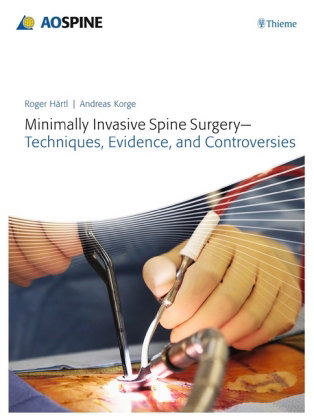
- Verlag: Thieme, Stuttgart
- Autor: Roger Haertl
- Artikel-Nr.: KNV34926647
- ISBN: 9783131723819
Minimally invasive spine surgery, in some form or other, has historical roots dating back more than 100 years, and recent advances in technology now make it increasingly effective in treating suitable spine patients. While minimally invasive approaches have shown to reduce muscle damage, blood loss, and post-operative pain, to perform this t ype of surgery correctly, even highly skilled modern-day surgeons must prepare themselves for a demanding learning curve.
For this reason, AOSpine proudly presents Minimally Invasive Spine Surgery: Techniques, Evidence, and Controversies, the most comprehensive book of its kind, which includes more than 500 pages of surgical techniques, illustrations, case images, tips and tricks, and research, providing an invaluable tool for spine surgeons around the world.
Each technique is fully examined:
- The pros and cons of each is objectively reviewed
- Its spectrum of indications and contraindications is summarized
- Historical and modern day controversies relating to each technique are discussed
- Uniquely, chapters in the text are further supported by an evidence-based section summarizing research studies, analysis, and conclusions into each technique, from peer-reviewed journals
The text covers more than just a range of interesting medical techniques. By including brief historical introductions on each technique and the surgeons that explored and founded its methods, their early (sometimes self-made) instrumentation, right through to todays current best-practice, this book provides an interesting, informative, and topical instruction on minimally invasive surgery and its increasingly encouraging results for spine-patient care.