






Diese Website verwendet Cookies und ähnliche Technologien. Dabei handelt es sich um kleine Textdateien, die auf eurem Computer gespeichert und ausgelesen werden. Indem ihr auf "Alles akzeptieren" klickt, stimmt ihr der Verarbeitung von Daten, der Erstellung und Verarbeitung von individuellen Nutzungsprofilen über Websites und über Partner und Geräte hinweg sowie der Übermittlung eurer Daten an Drittanbieter zu, die eure Daten teilweise in Ländern außerhalb der Europäischen Union verarbeiten (GDPR Art. 49). Einzelheiten hierzu findet ihr in den Datenschutzhinweisen. Die Daten werden für Analysen und für eigene Zwecke Dritter verwendet. Weitere Informationen, auch über die Datenverarbeitung durch Drittanbieter und die Möglichkeit des Widerrufs, findet ihr in den Einstellungen und in unseren Datenschutzhinweisen. Hier könnt ihr mit den notwendigen Tools fortfahren.
- Verlag: Springer, Berlin
- Autor: Mauri Valtonen
- Artikel-Nr.: KNV53430530
- ISBN: 9783319227252
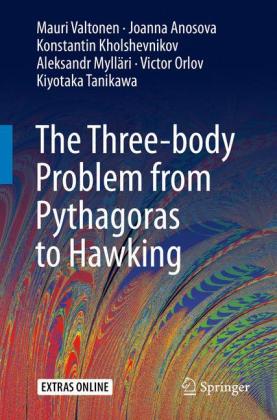
This book, written for a general readership, reviews and explains the three-body problem in historical context reaching to latest developments in computational physics and gravitation theory. The three-body problem is one of the oldest problems in science and it is most relevant even in today's physics and astronomy.
The long history of the problem from Pythagoras to Hawking parallels the evolution of ideas about our physical universe, with a particular emphasis on understanding gravity and how it operates between astronomical bodies. The oldest astronomical three-body problem is the question how and when the moon and the sun line up with the earth to produce eclipses. Once the universal gravitation was discovered by Newton, it became immediately a problem to understand why these three-bodies form a stable system, in spite of the pull exerted from one to the other. In fact, it was a big question whether this system is stable at all in the long run.
Leading mathematiciansattacked this problem over more than two centuries without arriving at a definite answer. The introduction of computers in the last half-a-century has revolutionized the study; now many answers have been found while new questions about the three-body problem have sprung up. One of the most recent developments has been in the treatment of the problem in Einstein's General Relativity, the new theory of gravitation which is an improvement on Newton's theory. Now it is possible to solve the problem for three black holes and to test one of the most fundamental theorems of black hole physics, the no-hair theorem, due to Hawking and his co-workers.