






Diese Website verwendet Cookies und ähnliche Technologien. Dabei handelt es sich um kleine Textdateien, die auf eurem Computer gespeichert und ausgelesen werden. Indem ihr auf "Alles akzeptieren" klickt, stimmt ihr der Verarbeitung von Daten, der Erstellung und Verarbeitung von individuellen Nutzungsprofilen über Websites und über Partner und Geräte hinweg sowie der Übermittlung eurer Daten an Drittanbieter zu, die eure Daten teilweise in Ländern außerhalb der Europäischen Union verarbeiten (GDPR Art. 49). Einzelheiten hierzu findet ihr in den Datenschutzhinweisen. Die Daten werden für Analysen und für eigene Zwecke Dritter verwendet. Weitere Informationen, auch über die Datenverarbeitung durch Drittanbieter und die Möglichkeit des Widerrufs, findet ihr in den Einstellungen und in unseren Datenschutzhinweisen. Hier könnt ihr mit den notwendigen Tools fortfahren.
- Verlag: Springer Netherlands
- Autor: Lemont B. Kier
- Artikel-Nr.: KNV14853760
- ISBN: 9781402036576
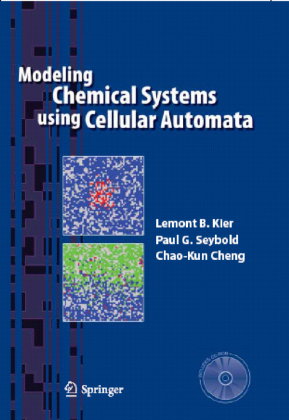
Modeling Chemical Systems using Cellular Automata provides a practical introduction to an exciting modeling paradigm for complex systems. The book first discusses the nature of scientific inquiry using models and simulations, and then describes the nature of cellular automata models. It then gives detailed descriptions, with examples and exercises, of how cellular automata models can be used in the study of a wide variety chemical, physical, and biochemical phenomena. Topics covered include models of water itself, solution phenomena, solution interactions with stationary systems, first- and second-order kinetic phenomena, enzyme kinetics, vapor-liquid equilibrium, and atomic and molecular excited-state kinetics. The student experiences these systems through hands-on examples and guided studies.
This book is the first of its kind: a textbook and a laboratory manual about cellular automata modeling of common systems in chemistry. The book is designed to be used as a text in undergraduate courses dealing with complex systems and/or as a computational supplement to laboratory courses taught at the undergraduate level.
The book includes:
- Compact descriptions of a large variety of physical and chemical phenomena
- Illustrative examples of simulations, with exercises for further study
- An instructor's manual for use of the program
The book will be of great value in undergraduate courses in chemistry, physics, biology, applied mathematics, and bioinformatics, and as a supplement for laboratory courses in introductory chemistry, organic chemistry, physical chemistry, medicinal chemistry, chemical engineering and other courses dealing with statistical and dynamic systems. It allows the exploration of a wide range of dynamic phenomena, many of which are not normally accessible within conventional laboratory settings due to limitations of time, cost, and experimental equipment.
Thebook is both a textbook on applied Cellular Automata and a lab manual for chemistry (physics, engineering) courses with lab activity. It would supplement other lab work and be an additonal book the students would use in the course.
The authors have assessed the emerging need for this kind of activity in science labs because of the cost of the practical activitites and the frequent failure of some exercises leading to lost didactic value of some experiments. This book is pioneering an alternative that will grow in use.
There are no course directors who would use Cellular Automata exclusively. The authors see an emerging interest in this kind of work in courses that contain lab exercises. One such course is the graduate course that Lemont Kier gives in Life Sciences about complexity. He uses many examples and studies from Cellular Automata in the latter part of this course.