






Diese Website verwendet Cookies und ähnliche Technologien. Dabei handelt es sich um kleine Textdateien, die auf eurem Computer gespeichert und ausgelesen werden. Indem ihr auf "Alles akzeptieren" klickt, stimmt ihr der Verarbeitung von Daten, der Erstellung und Verarbeitung von individuellen Nutzungsprofilen über Websites und über Partner und Geräte hinweg sowie der Übermittlung eurer Daten an Drittanbieter zu, die eure Daten teilweise in Ländern außerhalb der Europäischen Union verarbeiten (GDPR Art. 49). Einzelheiten hierzu findet ihr in den Datenschutzhinweisen. Die Daten werden für Analysen und für eigene Zwecke Dritter verwendet. Weitere Informationen, auch über die Datenverarbeitung durch Drittanbieter und die Möglichkeit des Widerrufs, findet ihr in den Einstellungen und in unseren Datenschutzhinweisen. Hier könnt ihr mit den notwendigen Tools fortfahren.
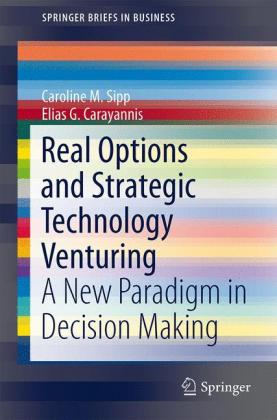
- Verlag: Springer, Berlin
- Autor: Caroline M. Sipp
- Artikel-Nr.: KNV34430928
- ISBN: 9781461458135
This book seeks to answer "why, when and how are real options used in strategic technology venturing?" This work tests for the role of real options in decision making involving three types of firms in decreasing order of technology-dependence - technology-driven (TD) (where the profit is fully dependent on new technology creation and leveraging), technology-based (TB) (where the profit is enabled and supported by technology) and technology-neutral (TN) (where the profit is almost independent of technology). It also deals with strategic and non-strategic types of decisions driven by real options.
This analysis shows that an environment presenting co-opetitive (simultaneous competition and collaboration) conditions triggers the use of real options (why), that serve to transform the position, posture and propensity of businesses to innovate and thus they co-evolve (when) into more effective and efficient forms of businesses (co-specialization) (how). The authors demonstrate that embracing risk and uncertainty can increase levels and probability of new venture formation. However, their simulation also shows that it should be adapted to the risk profile of the firm and that timing is also a factor to be considered. Although engaging the concepts of real options, this analysis does not focus on a specific investment valuation methodology, but highlights the relationship between knowledge and risk and rather addresses the management of mindsets, as moving towards a systematic conceptualization of real options represents a different paradigm in decision making.