


Diese Website verwendet Cookies und ähnliche Technologien. Dabei handelt es sich um kleine Textdateien, die auf eurem Computer gespeichert und ausgelesen werden. Indem ihr auf "Alles akzeptieren" klickt, stimmt ihr der Verarbeitung von Daten, der Erstellung und Verarbeitung von individuellen Nutzungsprofilen über Websites und über Partner und Geräte hinweg sowie der Übermittlung eurer Daten an Drittanbieter zu, die eure Daten teilweise in Ländern außerhalb der Europäischen Union verarbeiten (GDPR Art. 49). Einzelheiten hierzu findet ihr in den Datenschutzhinweisen. Die Daten werden für Analysen und für eigene Zwecke Dritter verwendet. Weitere Informationen, auch über die Datenverarbeitung durch Drittanbieter und die Möglichkeit des Widerrufs, findet ihr in den Einstellungen und in unseren Datenschutzhinweisen. Hier könnt ihr mit den notwendigen Tools fortfahren.
- Verlag: Springer, Berlin
- Autor: Tom Barnaby
- Artikel-Nr.: KNV17578874
- ISBN: 9781590595220
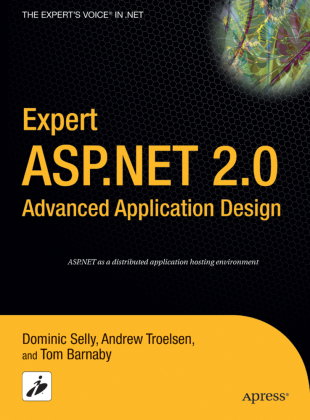
Expert ASP.NET 2.0 Advanced Application Design will help you derive maximum performance and reliability from the distributed applications you create with ASP.NET 2.0.
The book first looks at some of the non-functional requirements that impact the design of a distributed application. It then relates them to the servers and services available in the .NET 2.0 Framework. ASP.NET 2.0 is the central process for use in distributed .NET applications, and the book closely examines the ASP.NET 2.0 Framework and its hosting environment, Internet Information Server (IIS). The book looks at how ASP.NET 2.0 is used by different packages within .NET (like Web Services), and explores how it can be extended to meet your own custom requirements.
The second part of the book drills down and examines some of the common architectural challenges encountered when developing application designs. The book walks through the tiers of the .NET Framework, starting at the client level and exploring the internals of the page type, enhancements to ViewState, client script generation, and new out-of-band callbacks. At the middle tier, the book examines Web Services, Remoting, COM+, MSMQ, and mix and match communication options to suit your own requirements. This section wraps up by previewing Windows Communication Foundation, which aims to unify these technologies.
The third part of the book examines the data layer of your distributed applications. This includes enhancements to the Managed Providers in 2.0, the new transactional model, and a preview of usage guidelines for SQL Server 2005. By the books conclusion, you will be able to select with confidence the most appropriate design elements for your purposes, elegantly connecting them, and ensuring you get the very best from the ASP.NET 2.0 Framework.