






Diese Website verwendet Cookies und ähnliche Technologien. Dabei handelt es sich um kleine Textdateien, die auf eurem Computer gespeichert und ausgelesen werden. Indem ihr auf "Alles akzeptieren" klickt, stimmt ihr der Verarbeitung von Daten, der Erstellung und Verarbeitung von individuellen Nutzungsprofilen über Websites und über Partner und Geräte hinweg sowie der Übermittlung eurer Daten an Drittanbieter zu, die eure Daten teilweise in Ländern außerhalb der Europäischen Union verarbeiten (GDPR Art. 49). Einzelheiten hierzu findet ihr in den Datenschutzhinweisen. Die Daten werden für Analysen und für eigene Zwecke Dritter verwendet. Weitere Informationen, auch über die Datenverarbeitung durch Drittanbieter und die Möglichkeit des Widerrufs, findet ihr in den Einstellungen und in unseren Datenschutzhinweisen. Hier könnt ihr mit den notwendigen Tools fortfahren.
- Verlag: De Gruyter
- Autor: Marco Perale
- Artikel-Nr.: KNV34863198
- ISBN: 9783110295030
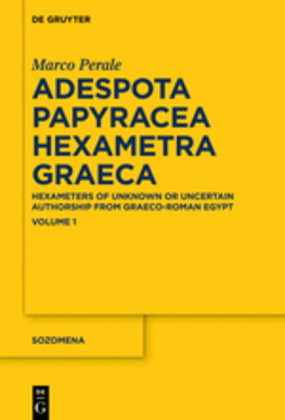
Adespota Papyracea Hexametra Graeca provides a comprehensive corpus of 'anonymous' hexameter texts on papyri, parchments, ostraca and tablets that have appeared in the current and past two centuries. The project has three main objectives: i) to retrieve and determine how many and what type of unidentified hexameter poems reached us via Egyptian papyri; ii) to restore a readable and reliable text for these poems, providing straightforward access to material that has been hard-to-reach in print format, is still unavailable online, or has not been previously translated into English or any other modern language; iii) to discuss, insofar as the fragmentary state of the evidence allows, issues of style, metre, and attribution. Overall, it aspires to serve as a fresh and solid starting-point for future assessment of Greek poetry in Egypt from the Archaic period to Late Antiquity.
This first volume of papyrus adespota contains: i) a catalogue of hexameter adespota, and ii) critical editions with English translation and commentary of: cosmologies and foundation poems (no. 01-06), astronomical and astrological texts (07-12), didactic and technical poetry (13-16), hymns (17-32), fragments of erotic content (33-38); epithalamia (39-43); and two hexameter anthologies, the Goodspeed papyrus (44) and the so-called Pamprepius codex (45). Future volumes will contain: Encomia and Lamentations (46-67); Bucolic (68-71), and Epic poetry (72-144); assemblages of Homeric verses (145-154); magical verses (155-166); oracles (167-169); fragments of uncertain genre or content (170-204); hexameter quotes from grammatical papyri and ancient commentaries (205-216); pi Gammani (217-219); gnomic hexameters (220-221); pangrams (222-235); texts copied or produced within a school context (236-242).