






Diese Website verwendet Cookies und ähnliche Technologien. Dabei handelt es sich um kleine Textdateien, die auf eurem Computer gespeichert und ausgelesen werden. Indem ihr auf "Alles akzeptieren" klickt, stimmt ihr der Verarbeitung von Daten, der Erstellung und Verarbeitung von individuellen Nutzungsprofilen über Websites und über Partner und Geräte hinweg sowie der Übermittlung eurer Daten an Drittanbieter zu, die eure Daten teilweise in Ländern außerhalb der Europäischen Union verarbeiten (GDPR Art. 49). Einzelheiten hierzu findet ihr in den Datenschutzhinweisen. Die Daten werden für Analysen und für eigene Zwecke Dritter verwendet. Weitere Informationen, auch über die Datenverarbeitung durch Drittanbieter und die Möglichkeit des Widerrufs, findet ihr in den Einstellungen und in unseren Datenschutzhinweisen. Hier könnt ihr mit den notwendigen Tools fortfahren.
- Verlag: Springer, Berlin
- Autor: Roberto Pasini
- Artikel-Nr.: KNV68387560
- ISBN: 9783319778860
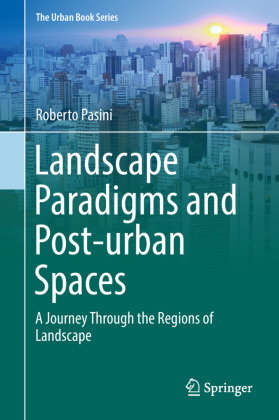
This book presents: 1) an urban-studies panorama on the emergence of a built/landscape continuum following the anthropic expansion at the geographic scale and the consequent demise of the city/country divide; 2) an in-depth theoretical analysis of disparate landscape constructs, culminating in the proposal of a comprehensive spatial paradigm addressing both manmade and natural contexts; 3) the in-situ transcription of the proposed spatial paradigm into a landscape installation implementing a territorial narrative in the Sierra Madre Oriental of Mexico. Foreword by Peter G. Rowe and afterword by Elisa C. Cattaneo.
By virtue of its openness, fluidity, and volatility, fluctuating between heterogeneity and diversity, today's built/landscape continuum exhibits analogies with distinct notions of landscape. The book determines an open-ended classification of contemporary space-making strategies exceeding the urban and metropolitan ambit, through a comparative anatomy of global case studies ranging from hard to soft: geotechnics or applied geographies, machinic micro-ecologies, aesthetic prostheses for operative metabolism, cybernetic utopias, atmospheric assemblages, psychic spheres, creole horizons, semiotic landscapes, geopolitical landscapes, geophilosophical excavations. The proposed spatial paradigm, accommodating aggregates of artificial and living systems, physical and mental spaces, and machinic and cultural landscapes, intends to reconcile the traditionally opposed 'scientific-cognitive-metabolist' and 'cultural-geophilosophical-territorialist' visions of the landscape. The resulting model transcends the exhausted myths of urban space, metropolitanism, and their filiations, in favor of a new form of urbanity and its attributes. Parts of the work were developed in the frame of research projects of Universidad de Monterrey and Parque Ecológico Chipinque and the IDAUP of UniFE and Polis.
The target audience of the book is researchers, teachers, andadvanced students engaged in landscape and urban studies with a prevalent focus on theory. The book can also benefit professional and institutional audiences looking for ethical/methodological orientation.