


Diese Website verwendet Cookies und ähnliche Technologien. Dabei handelt es sich um kleine Textdateien, die auf eurem Computer gespeichert und ausgelesen werden. Indem ihr auf "Alles akzeptieren" klickt, stimmt ihr der Verarbeitung von Daten, der Erstellung und Verarbeitung von individuellen Nutzungsprofilen über Websites und über Partner und Geräte hinweg sowie der Übermittlung eurer Daten an Drittanbieter zu, die eure Daten teilweise in Ländern außerhalb der Europäischen Union verarbeiten (GDPR Art. 49). Einzelheiten hierzu findet ihr in den Datenschutzhinweisen. Die Daten werden für Analysen und für eigene Zwecke Dritter verwendet. Weitere Informationen, auch über die Datenverarbeitung durch Drittanbieter und die Möglichkeit des Widerrufs, findet ihr in den Einstellungen und in unseren Datenschutzhinweisen. Hier könnt ihr mit den notwendigen Tools fortfahren.
- Verlag: Springer, Berlin
- Autor: Murad Jurdak
- Artikel-Nr.: KNV57225071
- ISBN: 9783319296548
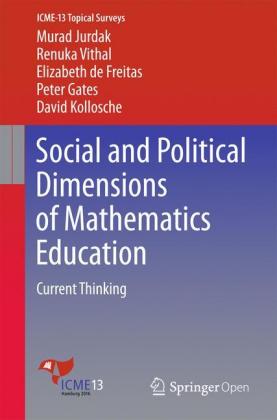
This book examines the current thinking on five critical social and political areas in mathematics education. It focuses on material conditions in teaching and learning, and details features of social life and their influence on mathematics teaching, learning and achievement. Following an introduction, the first section addresses equitable access and participation in quality mathematics education. It explores this issue in different contexts and from different ideological perspectives. The second section traces the emergence and development of the notion of activism in mathematics education in theory, in the literature, in research and in practice. The third section then moves on to explore current research on the political forces at work in identity, subjectivity and (dis)ability within mathematics education, showing how emphasis on language and discourse provides information for this research, and how new directions are being pursued to address the diverse material conditions thatshape learning experiences in mathematics education. Economic factors behind mathematics achievement form the topic of section four, which examines the political dimensions of mathematics education through the influence of national and global economic structures. The final section addresses distribution of power and cultural regimes of truth, based on the premise that although often deemed apolitical, mathematics and mathematics education are highly political institutions in our society. The book concludes with a summary and recommendations for the future.