


Diese Website verwendet Cookies und ähnliche Technologien. Dabei handelt es sich um kleine Textdateien, die auf eurem Computer gespeichert und ausgelesen werden. Indem ihr auf "Alles akzeptieren" klickt, stimmt ihr der Verarbeitung von Daten, der Erstellung und Verarbeitung von individuellen Nutzungsprofilen über Websites und über Partner und Geräte hinweg sowie der Übermittlung eurer Daten an Drittanbieter zu, die eure Daten teilweise in Ländern außerhalb der Europäischen Union verarbeiten (GDPR Art. 49). Einzelheiten hierzu findet ihr in den Datenschutzhinweisen. Die Daten werden für Analysen und für eigene Zwecke Dritter verwendet. Weitere Informationen, auch über die Datenverarbeitung durch Drittanbieter und die Möglichkeit des Widerrufs, findet ihr in den Einstellungen und in unseren Datenschutzhinweisen. Hier könnt ihr mit den notwendigen Tools fortfahren.
- Verlag: Springer, Berlin
- Autor: Jim Paterson
- Artikel-Nr.: KNV36494278
- ISBN: 9781590596562
To satisfy the demand for 24/7 information access, applications available in airport and conference kiosks, and in the mobile, gaming, and medical industries, provide consumers data access wherever they are. But it's essential that fast availability not be traded for quality performance.
A prominent solution for managing the data in these applications and devices is db4othe open source object database native to the Java and .NET platforms. Highly reliable and scalable, db4o cuts down on development time by smoothly integrating into the system, cutting out the otherwise costly object-relational mapping typical of larger applications.
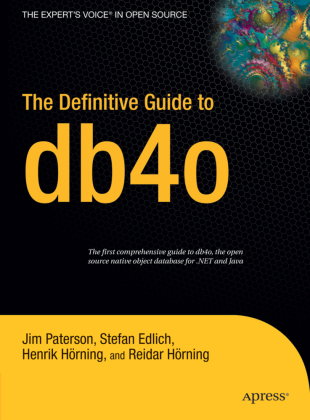
The Definitive Guide to db4o is the first book to comprehensively cover this project in detail. You will learn about all relevant topics, including installing and configuring db4o, querying and managing objects, performing transactions, and replicating data. To aid newcomers to the topic, early chapters cover object database fundamentals, as well as technical considerations and migration strategies. The book is complete with numerous C# and Java examples, so you'll be able to follow along regardless of your chosen language.