






Diese Website verwendet Cookies und ähnliche Technologien. Dabei handelt es sich um kleine Textdateien, die auf eurem Computer gespeichert und ausgelesen werden. Indem ihr auf "Alles akzeptieren" klickt, stimmt ihr der Verarbeitung von Daten, der Erstellung und Verarbeitung von individuellen Nutzungsprofilen über Websites und über Partner und Geräte hinweg sowie der Übermittlung eurer Daten an Drittanbieter zu, die eure Daten teilweise in Ländern außerhalb der Europäischen Union verarbeiten (GDPR Art. 49). Einzelheiten hierzu findet ihr in den Datenschutzhinweisen. Die Daten werden für Analysen und für eigene Zwecke Dritter verwendet. Weitere Informationen, auch über die Datenverarbeitung durch Drittanbieter und die Möglichkeit des Widerrufs, findet ihr in den Einstellungen und in unseren Datenschutzhinweisen. Hier könnt ihr mit den notwendigen Tools fortfahren.
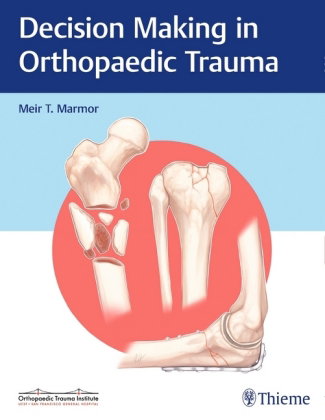
- Verlag: Thieme, Stuttgart
- Autor: Meir Marmor
- Artikel-Nr.: KNV62027871
- ISBN: 9781626234611
Unique decision-tree format provides rapid decision-making tool covering a wide range of musculoskeletal injuries
Few if any medical fields share the complexity of injuries and the number of available treatments that exist in orthopaedic trauma. Deciding on the most efficacious treatment can often be difficult. In this digital age with a tsunami of medical information and conflicting data on numerous approaches, practitioners who treat orthopaedic trauma often find it problematic to make "evidence-based" choices.
Decision Making in Orthopaedic Trauma is the largest compendium of orthopaedic trauma algorithms assembled to date. The decision trees cover a broad spectrum of cases - from simple isolated fractures - to severe, life-threatening conditions. The decisions on which action to perform in each situation are largely based on the personal experiences of the individual authors, all members of the University of California, San Francisco (UCSF) / Zuckerberg San Francisco General (ZSFG) Orthopaedic Trauma Institute. When the decisions are supported by published scientific literature, the relevant publications are cited.
Visually appealing, easy-to-comprehend decision trees detail underlying pathologies, suspected diagnoses, required imaging studies, possible treatment approaches, rehabilitation, expected outcomes, and postsurgical care. The format is more conducive to swiftly acquiring knowledge and making informed decisions than traditional texts and websites.
Key Features
- Management of a wide range of emergencies including compartment syndrome, open fractures, peripheral nerve injuries, mangled extremities, and multiple trauma
- Perioperative care - from acute and chronic pain management - to venous thromboembolism prevention and the use of regional anesthesia
- Major sections organized by anatomic region cover upper extremity, lower extremity, pelvic, hip, and spine trauma
- Clinical pearls on the management of osteoporotic, neoplastic, and periprosthetic fractures and fracture complications
- Impacted anatomy, differential diagnoses, and possible approaches visualized through high-quality color illustrations and radiographs
- Consistent color scheme differentiates actions, imaging, and rehabilitation guidelines
- Appendices provide a quick reference on imaging, bracing, and rehabilitation recommendations
This uniquely formatted, visually rich book will enable surgeons, physicians, and residents to understand and apply critical decisions to a wide range of fractures, dislocations, nerve injuries, and musculoskeletal complications.