






Diese Website verwendet Cookies und ähnliche Technologien. Dabei handelt es sich um kleine Textdateien, die auf eurem Computer gespeichert und ausgelesen werden. Indem ihr auf "Alles akzeptieren" klickt, stimmt ihr der Verarbeitung von Daten, der Erstellung und Verarbeitung von individuellen Nutzungsprofilen über Websites und über Partner und Geräte hinweg sowie der Übermittlung eurer Daten an Drittanbieter zu, die eure Daten teilweise in Ländern außerhalb der Europäischen Union verarbeiten (GDPR Art. 49). Einzelheiten hierzu findet ihr in den Datenschutzhinweisen. Die Daten werden für Analysen und für eigene Zwecke Dritter verwendet. Weitere Informationen, auch über die Datenverarbeitung durch Drittanbieter und die Möglichkeit des Widerrufs, findet ihr in den Einstellungen und in unseren Datenschutzhinweisen. Hier könnt ihr mit den notwendigen Tools fortfahren.
- Verlag: Springer, Berlin
- Autor: Klaus Jung
- Artikel-Nr.: KNV75347378
- ISBN: 9781493979875
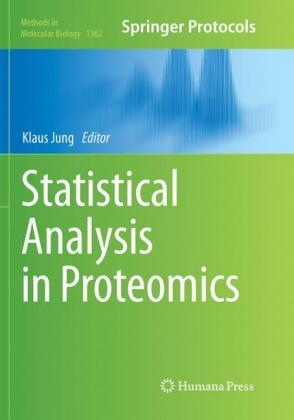
This valuable collection aims to provide a collection of frequently used statistical methods in the field of proteomics. Although there is a large overlap between statistical methods for the different 'omics' fields, methods for analyzing data from proteomics experiments need their own specific adaptations. To satisfy that need, Statistical Analysis in Proteomics focuses on the planning of proteomics experiments, the preprocessing and analysis of the data, the integration of proteomics data with other high-throughput data, as well as some special topics. Written for the highly successful Methods in Molecular Biology series, the chapters contain the kind of detail and expert implementation advice that makes for a smooth transition to the laboratory.
Practical and authoritative, Statistical Analysis in Proteomics serves as an ideal reference for statisticians involved in the planning and analysis of proteomics experiments, beginners as well as advanced researchers, and also for biologists, biochemists, and medical researchers who want to learn more about the statistical opportunities in the analysis of proteomics data.