






Diese Website verwendet Cookies und ähnliche Technologien. Dabei handelt es sich um kleine Textdateien, die auf eurem Computer gespeichert und ausgelesen werden. Indem ihr auf "Alles akzeptieren" klickt, stimmt ihr der Verarbeitung von Daten, der Erstellung und Verarbeitung von individuellen Nutzungsprofilen über Websites und über Partner und Geräte hinweg sowie der Übermittlung eurer Daten an Drittanbieter zu, die eure Daten teilweise in Ländern außerhalb der Europäischen Union verarbeiten (GDPR Art. 49). Einzelheiten hierzu findet ihr in den Datenschutzhinweisen. Die Daten werden für Analysen und für eigene Zwecke Dritter verwendet. Weitere Informationen, auch über die Datenverarbeitung durch Drittanbieter und die Möglichkeit des Widerrufs, findet ihr in den Einstellungen und in unseren Datenschutzhinweisen. Hier könnt ihr mit den notwendigen Tools fortfahren.
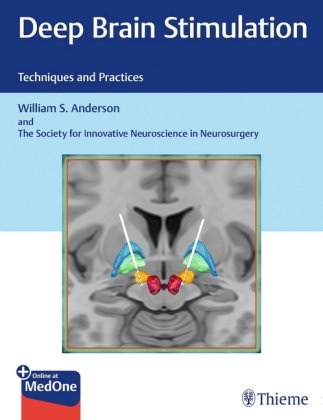
- Verlag: Thieme, Stuttgart
- Autor: William S. Anderson
- Artikel-Nr.: KNV76274944
- ISBN: 9781626237971
The one-stop resource on deep brain stimulation for functional neurosurgeons!
Deep brain stimulation (DBS) is used to modulate dysfunctional circuits in the brain with stimulation pulses applied to specific target areas of the brain. Globally, DBS procedures have been most commonly performed for Parkinson's disease and essential tremor, but there are now new and growing research efforts studying DBS for psychiatric disorders and epilepsy.
Deep Brain Stimulation: Techniques and Practices written by the Society for Innovative Neuroscience in Neurosurgery along with Dr. William S. Anderson and distinguished experts presents the latest DBS approaches. The book begins with a history of DBS, general frame-based techniques, patient selection primarily for movement disorders, multidisciplinary collaboration, and ethical considerations. Subsequent chapters detail diverse technologies and disease-specific treatment for Parkinson's disease, essential tremor, dystonia, OCD, epilepsy, major depression, Tourette syndrome, emerging psychiatric indications, and pediatric applications.
Key highlights
- Lead placement techniques utilizing currently available customized platforms and robotics
- Microelectrode recording and image-based direct targeting with MRI and CT to enhance lead placement
- Lesioning methods including radiofrequency, and MR-guided focused ultrasound
- Discussion of recent innovations in tractography to delineate white matter tracts in the brain and closed loop stimulation
DBS has helped thousands of patients with intractable conditions, allowing for a programmable therapy with durable treatment effect. This remarkable guide provides the essentials for functional neurosurgeons to pursue intraoperative research opportunities in this growing subspecialty and incorporate DBS into clinical practice.
This book includes complimentary access to a digital copy o