






Diese Website verwendet Cookies und ähnliche Technologien. Dabei handelt es sich um kleine Textdateien, die auf eurem Computer gespeichert und ausgelesen werden. Indem ihr auf "Alles akzeptieren" klickt, stimmt ihr der Verarbeitung von Daten, der Erstellung und Verarbeitung von individuellen Nutzungsprofilen über Websites und über Partner und Geräte hinweg sowie der Übermittlung eurer Daten an Drittanbieter zu, die eure Daten teilweise in Ländern außerhalb der Europäischen Union verarbeiten (GDPR Art. 49). Einzelheiten hierzu findet ihr in den Datenschutzhinweisen. Die Daten werden für Analysen und für eigene Zwecke Dritter verwendet. Weitere Informationen, auch über die Datenverarbeitung durch Drittanbieter und die Möglichkeit des Widerrufs, findet ihr in den Einstellungen und in unseren Datenschutzhinweisen. Hier könnt ihr mit den notwendigen Tools fortfahren.
- Verlag: Penguin Random House
- Autor: David Abram
- Artikel-Nr.: KNV81698277
- ISBN: 9780679776390
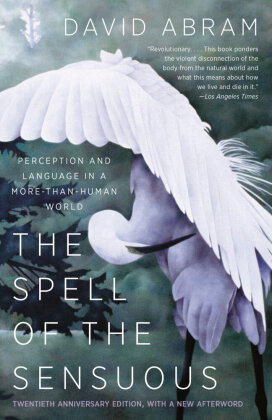
Animal tracks, word magic, the speech of stones, the power of letters, and the taste of the wind all figure prominently in this intellectual tour de force that returns us to our senses and to the sensuous terrain that sustains us. This major work of ecological philosophy startles the senses out of habitual ways of perception.
For a thousand generations, human beings viewed themselves as part of the wider community of nature, and they carried on active relationships not only with other people with other animals, plants, and natural objects (including mountains, rivers, winds, and weather patters) that we have only lately come to think of as "inanimate." How, then, did humans come to sever their ancient reciprocity with the natural world? What will it take for us to recover a sustaining relation with the breathing earth?
In The Spell of the Sensuous David Abram draws on sources as diverse as the philosophy of Merleau-Ponty, Balinese shamanism, Apache storytelling, and his own experience as an accomplished sleight-of-hand of magician to reveal the subtle dependence of human cognition on the natural environment. He explores the character of perception and excavates the sensual foundations of language, which--even at its most abstract--echoes the calls and cries of the earth. On every page of this lyrical work, Abram weaves his arguments with a passion, a precision, and an intellectual daring that recall such writers as Loren Eisleley, Annie Dillard, and Barry Lopez.