






Diese Website verwendet Cookies und ähnliche Technologien. Dabei handelt es sich um kleine Textdateien, die auf eurem Computer gespeichert und ausgelesen werden. Indem ihr auf "Alles akzeptieren" klickt, stimmt ihr der Verarbeitung von Daten, der Erstellung und Verarbeitung von individuellen Nutzungsprofilen über Websites und über Partner und Geräte hinweg sowie der Übermittlung eurer Daten an Drittanbieter zu, die eure Daten teilweise in Ländern außerhalb der Europäischen Union verarbeiten (GDPR Art. 49). Einzelheiten hierzu findet ihr in den Datenschutzhinweisen. Die Daten werden für Analysen und für eigene Zwecke Dritter verwendet. Weitere Informationen, auch über die Datenverarbeitung durch Drittanbieter und die Möglichkeit des Widerrufs, findet ihr in den Einstellungen und in unseren Datenschutzhinweisen. Hier könnt ihr mit den notwendigen Tools fortfahren.
- Verlag: Butterworth-Heinemann
- Autor: Alessio Pipinato
- Artikel-Nr.: KNV54001478
- ISBN: 9780128000588
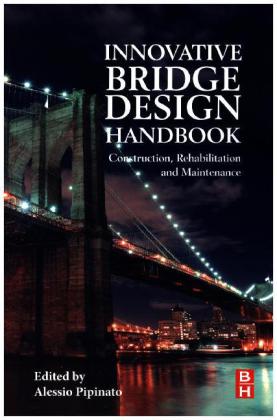
As known, each bridge presents a unique set of design, construction, and maintenance challenges. The designer must determine the appropriate methods and level of refinement necessary to design and analyze each bridge on a case-by-case basis. The Innovative Bridge Design Handbook: Construction, Rehabilitation, and Maintenance encompasses the state of the art in bridge design, construction, maintenance, and safety assessment. Written by an international group of experts, this book provides innovative design approaches used in various parts of the world and explores concepts in design, construction, and maintenance that will reduce project costs and increase structural safety and durability. Furthermore, research and innovative solutions are described throughout chapters.
The Innovative Bridge Design Handbook: Construction, Rehabilitation, and Maintenance brings together the specific knowledge of a bevy of experts and academics in bridge engineering in the areas of design, assessment, research, and construction. The handbook begins with an analysis of the history and development of bridge aesthetics and design; various types of loads including seismic and wind loads are then described, together with fatigue and fracture. Bridge design based on material such as reinforced concrete, prestressed reinforced concrete, steel and composite, timber, masonry bridges is analyzed and detailed according to international codes and standards. Then bridge design based on geometry, such as arch bridges, girders, cable stayed and suspension bridges, is illustrated. This is followed by a discussion of a number of special topics, including integral, movable, highway and railway bridges, together with seismic component devices, cables, orthotropic decks, foundations, and case studies. Finally, bridge construction equipment, bridge assessment retrofit and management, bridge monitoring, fiber-reinforced polymers to reinforce bridges, bridge collapse issues are covered.