






Diese Website verwendet Cookies und ähnliche Technologien. Dabei handelt es sich um kleine Textdateien, die auf eurem Computer gespeichert und ausgelesen werden. Indem ihr auf "Alles akzeptieren" klickt, stimmt ihr der Verarbeitung von Daten, der Erstellung und Verarbeitung von individuellen Nutzungsprofilen über Websites und über Partner und Geräte hinweg sowie der Übermittlung eurer Daten an Drittanbieter zu, die eure Daten teilweise in Ländern außerhalb der Europäischen Union verarbeiten (GDPR Art. 49). Einzelheiten hierzu findet ihr in den Datenschutzhinweisen. Die Daten werden für Analysen und für eigene Zwecke Dritter verwendet. Weitere Informationen, auch über die Datenverarbeitung durch Drittanbieter und die Möglichkeit des Widerrufs, findet ihr in den Einstellungen und in unseren Datenschutzhinweisen. Hier könnt ihr mit den notwendigen Tools fortfahren.
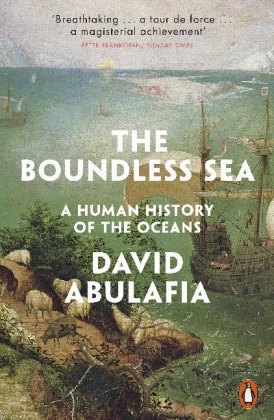
- Verlag: Penguin Books UK
- Autor: David Abulafia
- Artikel-Nr.: KNV82944430
- ISBN: 9780241956274
WINNER OF THE WOLFSON HISTORY PRIZE 2020
A SUNDAY TIMES, FINANCIAL TIMES, THE TIMES AND BBC HISTORY MAGAZINE BOOK OF THE YEAR
For most of human history, the seas and oceans have been the main means of long-distance trade and communication between peoples - for the spread of ideas and religion as well as commerce. This book traces the history of human movement and interaction around and across the world's greatest bodies of water, charting our relationship with the oceans from the time of the first voyagers. David Abulafia begins with the earliest of seafaring societies - the Polynesians of the Pacific, the possessors of intuitive navigational skills long before the invention of the compass, who by the first century were trading between their far-flung islands. By the seventh century, trading routes stretched from the coasts of Arabia and Africa to southern China and Japan, bringing together the Indian Ocean and the western Pacific and linking half the world through the international spice trade. In the Atlantic, centuries before the little kingdom of Portugal carved out its powerful, seaborne empire, many peoples sought new lands across the sea - the Bretons, the Frisians and, most notably, the Vikings, now known to be the first Europeans to reach North America. As Portuguese supremacy dwindled in the late sixteenth century, the Spanish, the Dutch and then the British each successively ruled the waves.
Following merchants, explorers, pirates, cartographers and travellers in their quests for spices, gold, ivory, slaves, lands for settlement and knowledge of what lay beyond, Abulafia has created an extraordinary narrative of humanity and the oceans. From the earliest forays of peoples in hand-hewn canoes through uncharted waters to the routes now taken daily by supertankers in their thousands, The Boundless Sea shows how maritime networks came to form a continuum of interaction and interconnection across the globe: 90 per cent of global trade is still conducted by sea. This is history of the grandest scale and scope, and from a bracingly different perspective - not, as in most global histories, from the land, but from the boundless seas.