






Diese Website verwendet Cookies und ähnliche Technologien. Dabei handelt es sich um kleine Textdateien, die auf eurem Computer gespeichert und ausgelesen werden. Indem ihr auf "Alles akzeptieren" klickt, stimmt ihr der Verarbeitung von Daten, der Erstellung und Verarbeitung von individuellen Nutzungsprofilen über Websites und über Partner und Geräte hinweg sowie der Übermittlung eurer Daten an Drittanbieter zu, die eure Daten teilweise in Ländern außerhalb der Europäischen Union verarbeiten (GDPR Art. 49). Einzelheiten hierzu findet ihr in den Datenschutzhinweisen. Die Daten werden für Analysen und für eigene Zwecke Dritter verwendet. Weitere Informationen, auch über die Datenverarbeitung durch Drittanbieter und die Möglichkeit des Widerrufs, findet ihr in den Einstellungen und in unseren Datenschutzhinweisen. Hier könnt ihr mit den notwendigen Tools fortfahren.
- Verlag: Random House UK
- Autor: Kevin Dutton
- Artikel-Nr.: KNV87823795
- ISBN: 9780552175364
A Malcolm Gladwell, Susan Cain, Daniel Pink and Adam Grant NEXT BIG IDEA book club read about how to avoid the pitfalls of too little, and too much, complexity.
'Essential insights into the character of human choice and decision-making.' ROBERT CIALDINI, bestselling author of Influence
________
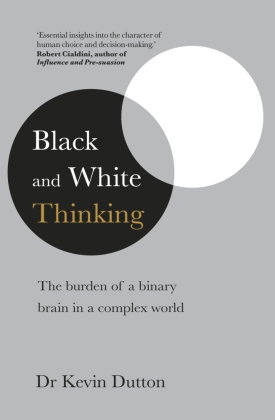
In this groundbreaking exploration of how our brains work, psychologist Professor Kevin Dutton explains that by understanding the nature of our hardwired black and white thinking we are better equipped to negotiate life's grey zones and make subtler and smarter decisions.
Our brains are hardwired to sort, categorize and draw lines. It's how we navigate the kaleidoscope of everyday information. Yet imagine failing an exam by a mere 1 per cent. Or being caught speeding at just 1 mph over the speed limit. We have to draw the line somewhere, we say. But lines can be unhelpful or even dangerous when drawn where they aren't wanted, or in too thick a hand.
By thinking in terms of ' 'them' or 'us' and 'this' or 'that' we isolate ourselves from ideas we don't agree with and people who are not the same as us. We fail to listen to the other side of the argument and beliefs become polarized. Intolerance and extremism flourish. The human race has survived by making binary decisions, but such thinking might also destroy us. We may be programmed to think in black and white but rainbow thinking is the key to our cognitive future.
__________
'Fascinating, important and entirely convincing.' SIR PHILIP PULLMAN