






Diese Website verwendet Cookies und ähnliche Technologien. Dabei handelt es sich um kleine Textdateien, die auf eurem Computer gespeichert und ausgelesen werden. Indem ihr auf "Alles akzeptieren" klickt, stimmt ihr der Verarbeitung von Daten, der Erstellung und Verarbeitung von individuellen Nutzungsprofilen über Websites und über Partner und Geräte hinweg sowie der Übermittlung eurer Daten an Drittanbieter zu, die eure Daten teilweise in Ländern außerhalb der Europäischen Union verarbeiten (GDPR Art. 49). Einzelheiten hierzu findet ihr in den Datenschutzhinweisen. Die Daten werden für Analysen und für eigene Zwecke Dritter verwendet. Weitere Informationen, auch über die Datenverarbeitung durch Drittanbieter und die Möglichkeit des Widerrufs, findet ihr in den Einstellungen und in unseren Datenschutzhinweisen. Hier könnt ihr mit den notwendigen Tools fortfahren.
- Verlag: Thieme, Stuttgart
- Autor: Patricia Zebrowski
- Artikel-Nr.: KNV88745531
- ISBN: 9781684202539
A student-friendly resource on stuttering and related fluency disorders by a who's who of global experts
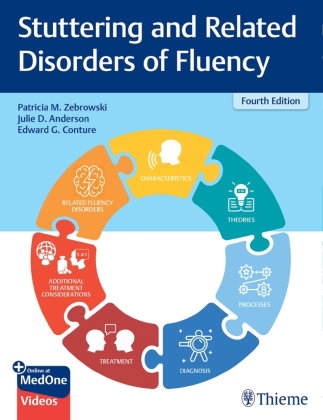
Stuttering and Related Disorders of Fluency, Fourth Edition honors the philosophy that discoveries of the past are the bedrock of the present and the inspiration for future explorations in this context the nature and treatment of stuttering. Initially developed over 30 years ago, the first two editions were edited by the late Richard F. Curlee and the third edition was co-edited by Richard F. Curlee and Edward G. Conture. The latest edition, co-edited by Patricia M. Zebrowski, Julie D. Anderson, and Edward G. Conture, brings together contemporary insights and a multinational perspective from 44 world-class academicians, clinicians, and researchers in the field of stuttering and related disorders.
The book is organized into six sections and 17 chapters, with the first section describing basic facts and theories. The second section covers genetic, neural, linguistic, cognitive, and physiological factors. The third section features three dedicated chapters on the diagnosis of preschool-age children, school-age children, and adolescents and adults. The fourth section discusses treatment guidelines with three chapters organized by the same age demographics, while the fifth section covers language and phonological, bilingual and multicultural, and pharmacological considerations for treatment. The sixth, and last, section provides guidance on cluttering and acquired stuttering from causes and symptoms to diagnosis and treatment.
Key Highlights
- Up-to-date, reader-friendly text is ideal for students with no or limited background or experience in the nature and treatment of stuttering and related fluency disorders
- Comprehensive content covering all relevant aspects of stuttering in diverse populations across the lifespan, including etiology, development, diagnosis, and treatment
- Contributions from a diverse group of top scholars and practitioners from the United States, Canada, Western Europe, and Australia
This text is essential reading for upper-class undergraduates and early-stage graduate students in communication sciences and disorders. It also provides an invaluable classroom tool for instructors teaching basic courses on this subject and is a helpful sourcebook for researchers investigating stuttering and related fluency disorders.
This print book includes complimentary access to a digital copy on https://medone.thieme.com.