






Diese Website verwendet Cookies und ähnliche Technologien. Dabei handelt es sich um kleine Textdateien, die auf eurem Computer gespeichert und ausgelesen werden. Indem ihr auf "Alles akzeptieren" klickt, stimmt ihr der Verarbeitung von Daten, der Erstellung und Verarbeitung von individuellen Nutzungsprofilen über Websites und über Partner und Geräte hinweg sowie der Übermittlung eurer Daten an Drittanbieter zu, die eure Daten teilweise in Ländern außerhalb der Europäischen Union verarbeiten (GDPR Art. 49). Einzelheiten hierzu findet ihr in den Datenschutzhinweisen. Die Daten werden für Analysen und für eigene Zwecke Dritter verwendet. Weitere Informationen, auch über die Datenverarbeitung durch Drittanbieter und die Möglichkeit des Widerrufs, findet ihr in den Einstellungen und in unseren Datenschutzhinweisen. Hier könnt ihr mit den notwendigen Tools fortfahren.
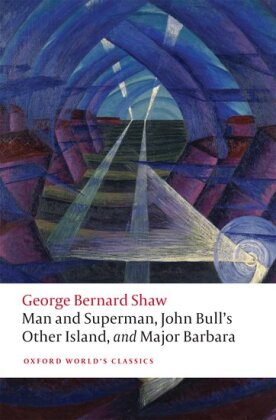
- Verlag: Oxford University Press
- Autor: George Bernard Shaw
- Artikel-Nr.: KNV89127504
- ISBN: 9780198828853
The three plays selected here are widely considered to be three of the most important in the canon of modern British theatre:
Man and Superman: a four-act comedy for serious people, staged in part at Royal court in 1905, it is one of the early works of Modernism to take an ancient myth and restage it in contemporary mode (and its influence extends across world literature, palpable in writings from Mann to Joyce). Its story of how a sensitive woman compels a superman-figure to adjust to her needs and those of the real world provides an updated commentary on Nietzsche's still-fashionable notions of ubermensch; and its famous third act introduces a persistent Shavian theme, which goes back as far as earliest religious literature-that the truly damned are those who are happy in hell.
John Bull's Other Island takes up that idea: to the visionary, hell may be the ultimate modern dream of efficiency and rational administration, as manifested in a colonial Ireland run by liberal exploiters. Commissioned by WB Yeats to mark the opening of Ireland's National Theatre, the Abbey, the play was promptly refused by its Directors (who disliked its mechanical mockeries of mechanism but may have missed its visionary qualities). It was performed to huge acclaim in London in November 1904 and it made Shaw famous, the supreme example of the Playwright as Thinker and, ever afterwards, one of the most valued commentators on Anglo-Irish relations.
Major Barbara: a three-act drama which in classic Shavian style unmasks the motivation of puritan idealists and dedicated industrialists, this work (like the previous two) pits a strong woman against a sardonic, practical man. Having exposed the mendacity of apostles of efficiency, Shaw seems then to submit to their doctrine, arguing that a pure private charity towards the destitute is no adequate substitute. Like the previous two works, this is a problem play, in the course of which the audience sympathy is aroused and then repelled in all directions. The suggestion that it may be acceptable to take money from tainted sources, such as arms manufacturers, caused much debate in 1905---and even more after the carnage wrought by mechanized guns in World War One.