






Diese Website verwendet Cookies und ähnliche Technologien. Dabei handelt es sich um kleine Textdateien, die auf eurem Computer gespeichert und ausgelesen werden. Indem ihr auf "Alles akzeptieren" klickt, stimmt ihr der Verarbeitung von Daten, der Erstellung und Verarbeitung von individuellen Nutzungsprofilen über Websites und über Partner und Geräte hinweg sowie der Übermittlung eurer Daten an Drittanbieter zu, die eure Daten teilweise in Ländern außerhalb der Europäischen Union verarbeiten (GDPR Art. 49). Einzelheiten hierzu findet ihr in den Datenschutzhinweisen. Die Daten werden für Analysen und für eigene Zwecke Dritter verwendet. Weitere Informationen, auch über die Datenverarbeitung durch Drittanbieter und die Möglichkeit des Widerrufs, findet ihr in den Einstellungen und in unseren Datenschutzhinweisen. Hier könnt ihr mit den notwendigen Tools fortfahren.
- Verlag: diaphanes
- Autor: Reiner Schürmann
- Artikel-Nr.: KNV90788451
- ISBN: 9783035804348
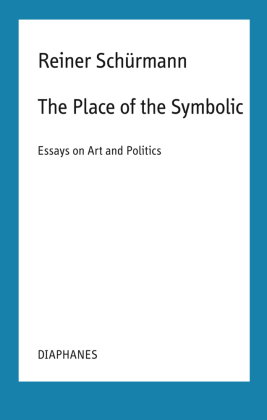
The Place of the Symbolic brings together Reiner Schürmann's essays on the nexus between art and politics. In keeping with his translation of the destruction of metaphysics into an an-archic philosophy of practice, Schürmann here develops a radically immanent theory of the place of symbols, irreducible to both Idealist theories and structuralist accounts of the symbolic such as Jacques Lacan's. Symbols, Schürmann argues in some of his earliest texts, may provide a bridge between ontological difference and politics. They resist being grasped metaphysically, in terms of representation. Instead their understanding requires a specific way of existence: attending to the coming-to-presence of phenomena. As such, the understanding of symbols discloses a form of praxis that abandons ultimate grounds and opens onto the manifold.
Alongside Schürmann's theory of symbols, the collection includes essays on the interaction of metaphysics, tragedy and technology, on the "there is" in poetry, as well as reflections on judgment. Throughout these characteristically lucid interventions, Schürmann's most urgent concern remains a consideration of singular and finite practices that enact a release from universal principles. Art and politics appear here as the unworking of ultimate grounds; that is, as practices attuned to a truly groundless form of life.