






Diese Website verwendet Cookies und ähnliche Technologien. Dabei handelt es sich um kleine Textdateien, die auf eurem Computer gespeichert und ausgelesen werden. Indem ihr auf "Alles akzeptieren" klickt, stimmt ihr der Verarbeitung von Daten, der Erstellung und Verarbeitung von individuellen Nutzungsprofilen über Websites und über Partner und Geräte hinweg sowie der Übermittlung eurer Daten an Drittanbieter zu, die eure Daten teilweise in Ländern außerhalb der Europäischen Union verarbeiten (GDPR Art. 49). Einzelheiten hierzu findet ihr in den Datenschutzhinweisen. Die Daten werden für Analysen und für eigene Zwecke Dritter verwendet. Weitere Informationen, auch über die Datenverarbeitung durch Drittanbieter und die Möglichkeit des Widerrufs, findet ihr in den Einstellungen und in unseren Datenschutzhinweisen. Hier könnt ihr mit den notwendigen Tools fortfahren.
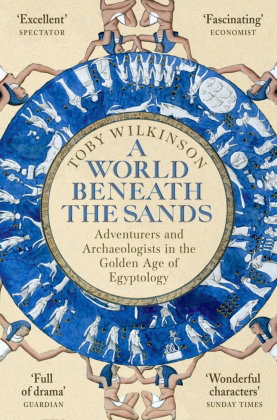
- Verlag: Macmillan Publishers International
- Autor: Toby Wilkinson
- Artikel-Nr.: KNV91792056
- ISBN: 9781509858736
'It is a story full of drama, with the Nile, the pyramids and the Valley of the Kings as backdrop. That A World Beneath the Sands is also a subtle and stimulating study of the paradoxes of 19th-century colonialism is a bonus indeed.' - Tom Holland, Guardian
What could be more exciting, more exotic or more intrepid than digging in the sands of Egypt in the hope of discovering golden treasures from the age of the pharaohs?
Our fascination with ancient Egypt goes back to the ancient Greeks. But the heyday of Egyptology was undoubtedly the nineteenth and early twentieth centuries. This golden age of scholarship and adventure is neatly book-ended by two epoch-making events: Champollion's decipherment of hieroglyphics in 1822 and the discovery of Tutankhamun's tomb by Howard Carter and Lord Carnarvon a hundred years later.
In A World Beneath the Sands, the acclaimed Egyptologist Toby Wilkinson tells the riveting stories of the men and women whose obsession with Egypt's ancient civilisation drove them to uncover its secrets. Champollion, Carter and Carnarvon are here, but so too are their lesser-known contemporaries, such as the Prussian scholar Karl Richard Lepsius, the Frenchman Auguste Mariette and the British aristocrat Lucie Duff-Gordon. Their work - and those of others like them - helped to enrich and transform our understanding of the Nile Valley and its people, and left a lasting impression on Egypt, too. Travellers and treasure-hunters, ethnographers and epigraphers, antiquarians and archaeologists: whatever their motives, whatever their methods, all understood that in pursuing Egyptology they were part of a greater endeavour - to reveal a lost world, buried for centuries beneath the sands.