






Diese Website verwendet Cookies und ähnliche Technologien. Dabei handelt es sich um kleine Textdateien, die auf eurem Computer gespeichert und ausgelesen werden. Indem ihr auf "Alles akzeptieren" klickt, stimmt ihr der Verarbeitung von Daten, der Erstellung und Verarbeitung von individuellen Nutzungsprofilen über Websites und über Partner und Geräte hinweg sowie der Übermittlung eurer Daten an Drittanbieter zu, die eure Daten teilweise in Ländern außerhalb der Europäischen Union verarbeiten (GDPR Art. 49). Einzelheiten hierzu findet ihr in den Datenschutzhinweisen. Die Daten werden für Analysen und für eigene Zwecke Dritter verwendet. Weitere Informationen, auch über die Datenverarbeitung durch Drittanbieter und die Möglichkeit des Widerrufs, findet ihr in den Einstellungen und in unseren Datenschutzhinweisen. Hier könnt ihr mit den notwendigen Tools fortfahren.
- Verlag: MIT Press
- Autor: Thomas Haigh
- Artikel-Nr.: KNV92644857
- ISBN: 9780262542906
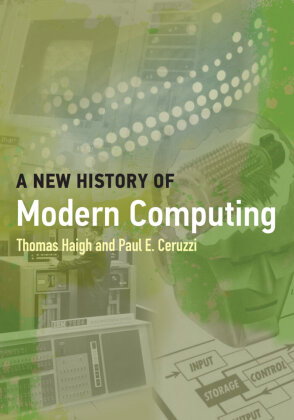
Over the past fifty years, the computer has been transformed from a hulking scientific supertool and data processing workhorse, remote from the experiences of ordinary people, to a diverse family of devices that billions rely on to play games, shop, stream music and movies, communicate, and count their steps. In A New History of Modern Computing, Thomas Haigh and Paul Ceruzzi trace these changes. A comprehensive reimagining of Ceruzzi's A History of Modern Computing, this new volume uses each chapter to recount one such transformation, describing how a particular community of users and producers remade the computer into something new.
Haigh and Ceruzzi ground their accounts of these computing revolutions in the longer and deeper history of computing technology. They begin with the story of the 1945 ENIAC computer, which introduced the vocabulary of "programs" and "programming," and proceed through email, pocket calculators, personal computers, the World Wide Web, videogames, smart phones, and our current world of computers everywhere--in phones, cars, appliances, watches, and more. Finally, they consider the Tesla Model S as an object that simultaneously embodies many strands of computing.