






Diese Website verwendet Cookies und ähnliche Technologien. Dabei handelt es sich um kleine Textdateien, die auf eurem Computer gespeichert und ausgelesen werden. Indem ihr auf "Alles akzeptieren" klickt, stimmt ihr der Verarbeitung von Daten, der Erstellung und Verarbeitung von individuellen Nutzungsprofilen über Websites und über Partner und Geräte hinweg sowie der Übermittlung eurer Daten an Drittanbieter zu, die eure Daten teilweise in Ländern außerhalb der Europäischen Union verarbeiten (GDPR Art. 49). Einzelheiten hierzu findet ihr in den Datenschutzhinweisen. Die Daten werden für Analysen und für eigene Zwecke Dritter verwendet. Weitere Informationen, auch über die Datenverarbeitung durch Drittanbieter und die Möglichkeit des Widerrufs, findet ihr in den Einstellungen und in unseren Datenschutzhinweisen. Hier könnt ihr mit den notwendigen Tools fortfahren.
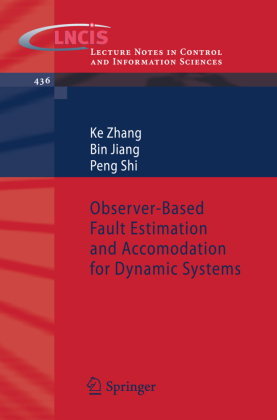
- Verlag: Springer, Berlin
- Autor: Ke Zhang
- Artikel-Nr.: KNV34600467
- ISBN: 9783642339851
Due to the increasing security and reliability demand of actual industrial process control systems, the study on fault diagnosis and fault tolerant control of dynamic systems has received considerable attention. Fault accommodation (FA) is one of effective methods that can be used to enhance system stability and reliability, so it has been widely and in-depth investigated and become a hot topic in recent years.
Fault detection is used to monitor whether a fault occurs, which is the first step in FA. On the basis of fault detection, fault estimation (FE) is utilized to determine online the magnitude of the fault, which is a very important step because the additional controller is designed using the fault estimate. Compared with fault detection, the design difficulties of FE would increase a lot, so research on FE and accommodation is very challenging. Although there have been advancements reported on FE and accommodation for dynamic systems, the common methods at the present stage have design difficulties, which limit applications of respective design approaches.
Therefore, the problems of FE and accommodation are needed to be further studied. This book considers the theory and technology of FE and accommodation for dynamic systems, and establishes a systemic and comprehensive framework of FE and accommodation for continuous/discrete-time systems.