






Diese Website verwendet Cookies und ähnliche Technologien. Dabei handelt es sich um kleine Textdateien, die auf eurem Computer gespeichert und ausgelesen werden. Indem ihr auf "Alles akzeptieren" klickt, stimmt ihr der Verarbeitung von Daten, der Erstellung und Verarbeitung von individuellen Nutzungsprofilen über Websites und über Partner und Geräte hinweg sowie der Übermittlung eurer Daten an Drittanbieter zu, die eure Daten teilweise in Ländern außerhalb der Europäischen Union verarbeiten (GDPR Art. 49). Einzelheiten hierzu findet ihr in den Datenschutzhinweisen. Die Daten werden für Analysen und für eigene Zwecke Dritter verwendet. Weitere Informationen, auch über die Datenverarbeitung durch Drittanbieter und die Möglichkeit des Widerrufs, findet ihr in den Einstellungen und in unseren Datenschutzhinweisen. Hier könnt ihr mit den notwendigen Tools fortfahren.
- Verlag: Thieme, Stuttgart
- Autor: Narayan Jayashankar
- Artikel-Nr.: KNV95405432
- ISBN: 9789390553136
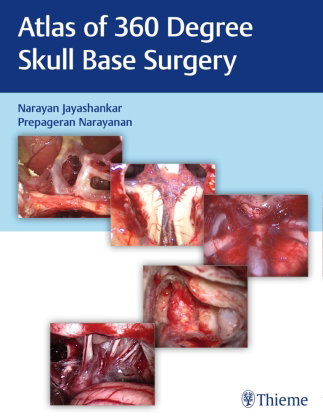
Skull base surgery has evolved over the last decade into a symbiotic combination of cutting-edge technology and surgical skills. From the ORL perspective, skull base is usually performed by three separate teams, namely, rhinologist who performs the endoscopic transnasal skull base surgery, neurotologist who performs posterolateral skull base, and head and neck surgeon who performs the open skull base approaches. These traditional division, although still very much applicable in most countries, is now being challenged by some group of surgeons who perform the entire skull base surgery.
The editors of this surgical atlas belong to this group who performs the entire range of skull base as the surgical skills and instruments are interchangeable. Current fellowship includes exposure to the entire range of skull base, thus pioneering a younger generation of skull base surgeons who inherit the same versatility and technical capability of performing the entire range of skull base surgery. Many colleagues around the globe practice a single corridor of approaches. However, we believe in practicing 360-degree skull base, thus the need for this unique atlas that encompasses the entire skull base.
Key Features:
- Step-by-step description of procedures with detailed photographs
- More than 2,000 high-definition photographs to enhance the understanding of the text
- Detailed description of tips, tricks, and pitfalls to be avoided is covered in the atlas.
- Complications and their management, reconstruction of skull base defects, and rehabilitation chapters
- Comprehensive overview of pituitary tumors, craniopharyngioma, meningioma, craniovertebral junction pathologies, and chordoma