






Diese Website verwendet Cookies und ähnliche Technologien. Dabei handelt es sich um kleine Textdateien, die auf eurem Computer gespeichert und ausgelesen werden. Indem ihr auf "Alles akzeptieren" klickt, stimmt ihr der Verarbeitung von Daten, der Erstellung und Verarbeitung von individuellen Nutzungsprofilen über Websites und über Partner und Geräte hinweg sowie der Übermittlung eurer Daten an Drittanbieter zu, die eure Daten teilweise in Ländern außerhalb der Europäischen Union verarbeiten (GDPR Art. 49). Einzelheiten hierzu findet ihr in den Datenschutzhinweisen. Die Daten werden für Analysen und für eigene Zwecke Dritter verwendet. Weitere Informationen, auch über die Datenverarbeitung durch Drittanbieter und die Möglichkeit des Widerrufs, findet ihr in den Einstellungen und in unseren Datenschutzhinweisen. Hier könnt ihr mit den notwendigen Tools fortfahren.
- Verlag: Ernst & Sohn
- Autor: Georgios Gaganelis
- Artikel-Nr.: KNV93095691
- ISBN: 9783433033371
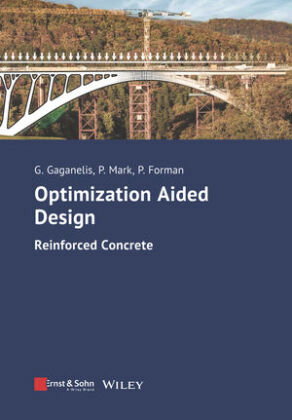
Three topics are addressed. First, the identification of the structure. This means the question of the right outer shape such that slender load-bearing designs develop following the flux of forces. In line with the stress affinity of the material, the structures are predominantly subjected to compression. Second, the reinforcement layout, which is oriented to the stress trajectories. Advantages arise particularly for walls, voluminous structural components, load introduction areas and cut-outs. Clear strut-and-tie models emerge that are directly convertible into reinforcement layouts. Third, the treatment of cross-sections. They are optimized in their shape and designed in their reinforcement. This also applies to sophisticated loading conditions (biaxial bending) and virtually arbitrary geometrical configurations. Parameterization allows the transfer to general cross-section types.
The optimization aided methods are described extensively and in an illustrative manner. They are universally applicable and independent of standards, concrete types and reinforcements. They apply to normal strength to ultra-high performance concretes, to reinforcements made of steel, carbon or glass fibers, and to rebars as well as reinforcing fibers. Numerous illustrations and computation examples demonstrate their application. Moreover, practical applications are presented, including ultra-light concrete-steel beams, slender concrete solar collectors, and improved reinforcement layouts for tunnel lining. The book addresses students, researchers, and practitioners alike.