






Diese Website verwendet Cookies und ähnliche Technologien. Dabei handelt es sich um kleine Textdateien, die auf eurem Computer gespeichert und ausgelesen werden. Indem ihr auf "Alles akzeptieren" klickt, stimmt ihr der Verarbeitung von Daten, der Erstellung und Verarbeitung von individuellen Nutzungsprofilen über Websites und über Partner und Geräte hinweg sowie der Übermittlung eurer Daten an Drittanbieter zu, die eure Daten teilweise in Ländern außerhalb der Europäischen Union verarbeiten (GDPR Art. 49). Einzelheiten hierzu findet ihr in den Datenschutzhinweisen. Die Daten werden für Analysen und für eigene Zwecke Dritter verwendet. Weitere Informationen, auch über die Datenverarbeitung durch Drittanbieter und die Möglichkeit des Widerrufs, findet ihr in den Einstellungen und in unseren Datenschutzhinweisen. Hier könnt ihr mit den notwendigen Tools fortfahren.
- Verlag: Thieme, Stuttgart
- Autor: Sabrina Campbell
- Artikel-Nr.: KNV94489457
- ISBN: 9781684204915
Revised edition of widely acclaimed medical training resource features extensive and invaluable additions
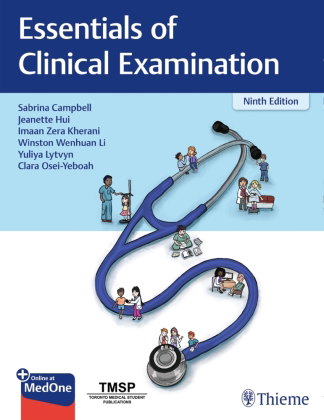
Performing clinical examinations is an important skill developed throughout medical training and vocational experience. For nearly a quarter century, this learner-friendly handbook has filled a gap in the literature by providing an affordable and portable resource on clinical examination best practices. Essentials of Clinical Examination, 9th Edition reflects contributions from 119 medical students, 44 residents, 16 artists, 6 layout editors, and 38 esteemed faculty members at the University of Toronto. Supported by Toronto Medical Student Publications, each chapter has been thoroughly reviewed by expert residents and faculty members in their respective specialties to ensure the highest caliber content.
Created by health learners for health learners, this highly accessible, evidence-informed reference is indispensable for clinical rotations and OSCE preparation. All 24 chapters underwent extensive revisions to reflect the most pertinent, up-to-date information. Section one provides overviews of major anatomy and body systems, while section two is organized by subspecialty. Each of the subspecialty chapters is consistently formatted with detailed and clear explanations covering clinical history, common presentations, differential diagnoses with distinguishing clinical features, and physical examination maneuvers.
Key Highlights
- The addition of new summary tables, detailed diagrams, and improved graphics enhance understanding and retention of knowledge
- New social, pediatric, and geriatric awareness pearls help learners better contextualize concepts through a culturally and socially sensitive lens
- Integrated clinical questions at the end of each chapter enable readers to consolidate knowledge and apply it to real-life situations encountered during rotations