






Diese Website verwendet Cookies und ähnliche Technologien. Dabei handelt es sich um kleine Textdateien, die auf eurem Computer gespeichert und ausgelesen werden. Indem ihr auf "Alles akzeptieren" klickt, stimmt ihr der Verarbeitung von Daten, der Erstellung und Verarbeitung von individuellen Nutzungsprofilen über Websites und über Partner und Geräte hinweg sowie der Übermittlung eurer Daten an Drittanbieter zu, die eure Daten teilweise in Ländern außerhalb der Europäischen Union verarbeiten (GDPR Art. 49). Einzelheiten hierzu findet ihr in den Datenschutzhinweisen. Die Daten werden für Analysen und für eigene Zwecke Dritter verwendet. Weitere Informationen, auch über die Datenverarbeitung durch Drittanbieter und die Möglichkeit des Widerrufs, findet ihr in den Einstellungen und in unseren Datenschutzhinweisen. Hier könnt ihr mit den notwendigen Tools fortfahren.
- Verlag: MIT Press
- Autor: Henry T. Greely
- Artikel-Nr.: KNV95415866
- ISBN: 9780262543880
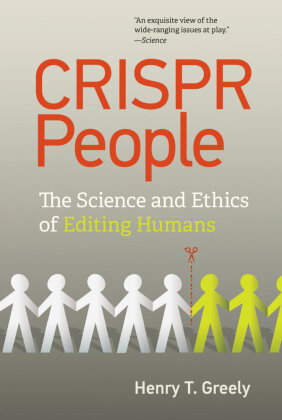
In November 2018, the world was shocked to learn that two babies had been born in China with DNA edited while they were embryos as dramatic a development in genetics as the 1996 cloning of Dolly the sheep. In this book, Hank Greely, a leading authority on law and genetics, tells the fascinating story of this human experiment and its consequences. Greely explains what Chinese scientist He Jiankui did, how he did it, and how the public and other scientists learned about and reacted to this unprecedented genetic intervention.
The two babies, nonidentical twin girls, were the first CRISPR'd people ever born (CRISPR, Clustered Regularly Interspaced Short Palindromic Repeats, is a powerful gene-editing method). Greely not only describes He's experiment and its public rollout (aided by a public relations adviser) but also considers, in a balanced and thoughtful way, the lessons to be drawn both from these CRISPR'd babies and, more broadly, from this kind of human DNA editing germline editing that can be passed on from one generation to the next.
Greely doesn't mince words, describing He's experiment as grossly reckless, irresponsible, immoral, and illegal. Although he sees no inherent or unmanageable barriers to human germline editing, he also sees very few good uses for it other, less risky, technologies can achieve the same benefits. We should consider the implications carefully before we proceed.