






Diese Website verwendet Cookies und ähnliche Technologien. Dabei handelt es sich um kleine Textdateien, die auf eurem Computer gespeichert und ausgelesen werden. Indem ihr auf "Alles akzeptieren" klickt, stimmt ihr der Verarbeitung von Daten, der Erstellung und Verarbeitung von individuellen Nutzungsprofilen über Websites und über Partner und Geräte hinweg sowie der Übermittlung eurer Daten an Drittanbieter zu, die eure Daten teilweise in Ländern außerhalb der Europäischen Union verarbeiten (GDPR Art. 49). Einzelheiten hierzu findet ihr in den Datenschutzhinweisen. Die Daten werden für Analysen und für eigene Zwecke Dritter verwendet. Weitere Informationen, auch über die Datenverarbeitung durch Drittanbieter und die Möglichkeit des Widerrufs, findet ihr in den Einstellungen und in unseren Datenschutzhinweisen. Hier könnt ihr mit den notwendigen Tools fortfahren.
- Verlag: Taylor & Francis
- Autor: Kristian Ulrichsen
- Artikel-Nr.: KNV49582922
- ISBN: 9781138813656
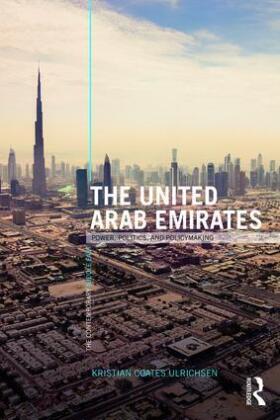
Led by Dubai and Abu Dhabi, the UAE has become deeply embedded in the contemporary system of international power, politics, and policy-making. Only an independent state since 1971, the seven emirates that constitute the UAE represent not only the most successful Arab federal experiment but also the most durable. However, the 2008 financial crisis and its aftermath underscored the continuing imbalance between Abu Dhabi and Dubai and the five northern emirates. Meanwhile, the post-2011 security crackdown revealed the acute sensitivity of officials in Abu Dhabi to social inequalities and economic disparities across the federation.
The United Arab Emirates: Power, Politics, and Policymaking charts the various processes of state formation and political and economic development that have enabled the UAE to emerge as a significant regional power and major player in the post Arab Spring reordering of Middle East and North African Politics, as well as the closest partner of the US in military and security affairs in the region. It also explores the seamier underside of that growth in terms of the condition of migrant workers, recent interventions in Libya and Yemen, and, latterly, one of the highest rates of political prisoners per capita in the world. The book concludes with a discussion of the likely policy challenges that the UAE will face in coming years, especially as it moves towards its fiftieth anniversary in 2021.
Providing a comprehensive and accessible assessment of the UAE, this book will be a vital resource for students and scholars of International Relations and Middle East Studies, as well as non-specialists with an interest in the United Arab Emirates and its global position.