






Diese Website verwendet Cookies und ähnliche Technologien. Dabei handelt es sich um kleine Textdateien, die auf eurem Computer gespeichert und ausgelesen werden. Indem ihr auf "Alles akzeptieren" klickt, stimmt ihr der Verarbeitung von Daten, der Erstellung und Verarbeitung von individuellen Nutzungsprofilen über Websites und über Partner und Geräte hinweg sowie der Übermittlung eurer Daten an Drittanbieter zu, die eure Daten teilweise in Ländern außerhalb der Europäischen Union verarbeiten (GDPR Art. 49). Einzelheiten hierzu findet ihr in den Datenschutzhinweisen. Die Daten werden für Analysen und für eigene Zwecke Dritter verwendet. Weitere Informationen, auch über die Datenverarbeitung durch Drittanbieter und die Möglichkeit des Widerrufs, findet ihr in den Einstellungen und in unseren Datenschutzhinweisen. Hier könnt ihr mit den notwendigen Tools fortfahren.
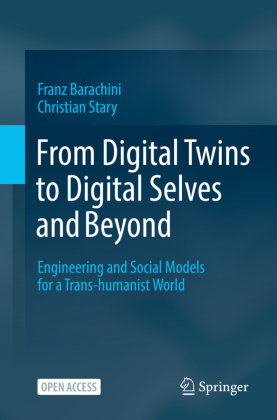
- Verlag: Springer, Berlin
- Autor: Franz Barachini
- Artikel-Nr.: KNV95443396
- ISBN: 9783030964115
This open access book aims at deepening the understanding of the relation between cyber-physical systems (CPSs) as socio-technical systems and their digital representations with intertwined artificial intelligence (AI). The authors describe why it is crucial for digital selves to be able to develop emotional behavior and why a humanity-inspired AI is necessary so that humans and humanoids can coexist.
The introductory chapter describes major milestones in computer science which form the basis for the implementation of digital twins and digital selves. The subsequent Part I then lays the foundation to develop a socio-technical understanding of the nature of digital twins as representations and trans-human development objects. Following the conceptual understanding of digital twins and how they could be engineered according to cognitive and organizational structures, Part II forms the groundwork for understanding social behavior and its modeling. It discusses various perception-based socio-emotional approaches before sketching behavior-relevant models and their simulation capabilities. In particular, it is shown how emotions can substantially influence the collective behavior of artificial actors. Part III eventually presents a symbiosis showing under which preconditions digital selves might construct and produce digital twins as integrated design elements in trans-human ecosystems. The chapters in this part are dedicated to opportunities and modes of co-creating reflective socio-trans-human systems based on digital twin models, exploring mutual control and continuous development. The final epilog is congenitally speculative in its nature by presenting thoughts on future developments of artificial life in computational substrates.
The book is written for researchers and professionals in areas like cyber-physical systems, robotics, social simulation or systems engineering, interested to take a speculative look into the future of digital twins and autonomous agents. It also touches upon philosophical aspects of digital twins, digital selves and humanoids.