






Diese Website verwendet Cookies und ähnliche Technologien. Dabei handelt es sich um kleine Textdateien, die auf eurem Computer gespeichert und ausgelesen werden. Indem ihr auf "Alles akzeptieren" klickt, stimmt ihr der Verarbeitung von Daten, der Erstellung und Verarbeitung von individuellen Nutzungsprofilen über Websites und über Partner und Geräte hinweg sowie der Übermittlung eurer Daten an Drittanbieter zu, die eure Daten teilweise in Ländern außerhalb der Europäischen Union verarbeiten (GDPR Art. 49). Einzelheiten hierzu findet ihr in den Datenschutzhinweisen. Die Daten werden für Analysen und für eigene Zwecke Dritter verwendet. Weitere Informationen, auch über die Datenverarbeitung durch Drittanbieter und die Möglichkeit des Widerrufs, findet ihr in den Einstellungen und in unseren Datenschutzhinweisen. Hier könnt ihr mit den notwendigen Tools fortfahren.
- Verlag: Springer, Berlin
- Autor: Geir Evensen
- Artikel-Nr.: KNV95461354
- ISBN: 9783030967086
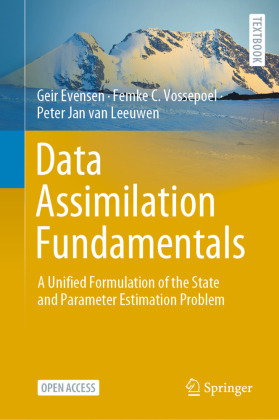
This open-access textbook's significant contribution is the unified derivation of data-assimilation techniques from a common fundamental and optimal starting point, namely Bayes' theorem. Unique for this book is the "top-down" derivation of the assimilation methods. It starts from Bayes theorem and gradually introduces the assumptions and approximations needed to arrive at today's popular data-assimilation methods. This strategy is the opposite of most textbooks and reviews on data assimilation that typically take a bottom-up approach to derive a particular assimilation method. E.g., the derivation of the Kalman Filter from control theory and the derivation of the ensemble Kalman Filter as a low-rank approximation of the standard Kalman Filter. The bottom-up approach derives the assimilation methods from different mathematical principles, making it difficult to compare them. Thus, it is unclear which assumptions are made to derive an assimilation method and sometimes even which problem it aspires to solve. The book's top-down approach allows categorizing data-assimilation methods based on the approximations used. This approach enables the user to choose the most suitable method for a particular problem or application. Have you ever wondered about the difference between the ensemble 4DVar and the "ensemble randomized likelihood" (EnRML) methods? Do you know the differences between the ensemble smoother and the ensemble-Kalman smoother? Would you like to understand how a particle flow is related to a particle filter? In this book, we will provide clear answers to several such questions. The book provides the basis for an advanced course in data assimilation. It focuses on the unified derivation of the methods and illustrates their properties on multiple examples. It is suitable for graduate students, post-docs, scientists, and practitioners working in data assimilation.