






Diese Website verwendet Cookies und ähnliche Technologien. Dabei handelt es sich um kleine Textdateien, die auf eurem Computer gespeichert und ausgelesen werden. Indem ihr auf "Alles akzeptieren" klickt, stimmt ihr der Verarbeitung von Daten, der Erstellung und Verarbeitung von individuellen Nutzungsprofilen über Websites und über Partner und Geräte hinweg sowie der Übermittlung eurer Daten an Drittanbieter zu, die eure Daten teilweise in Ländern außerhalb der Europäischen Union verarbeiten (GDPR Art. 49). Einzelheiten hierzu findet ihr in den Datenschutzhinweisen. Die Daten werden für Analysen und für eigene Zwecke Dritter verwendet. Weitere Informationen, auch über die Datenverarbeitung durch Drittanbieter und die Möglichkeit des Widerrufs, findet ihr in den Einstellungen und in unseren Datenschutzhinweisen. Hier könnt ihr mit den notwendigen Tools fortfahren.
- Verlag: Springer, Berlin
- Autor: Sarah Byrne
- Artikel-Nr.: KNV34879214
- ISBN: 9781461429173
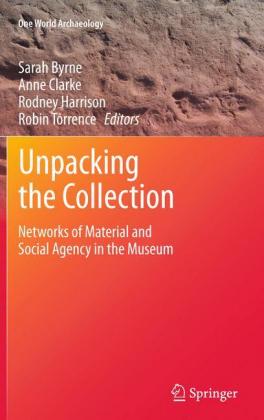
Museum collections are often perceived as static entities hidden away in storerooms or trapped behind glass cases. By focusing on the dynamic histories of museum collections, new research reveals their pivotal role in shaping a wide range of social relations. Over time and across space the interactions between these artefacts and the people and institutions who made, traded, collected, researched and exhibited them have generated complex networks of material and social agency.
In this innovative volume, the contributors draw on a broad range of source materials to explore the cross-cultural interactions which have created museum collections. These case studies contribute significantly to the development of new theoretical frameworks to examine broader questions of materiality, agency, and identity in the past and present.
Grounded in case studies from individual objects and museum collections from North America, Europe, Africa, the Pacific Islands, and Australia, this truly international volume juxtaposes historical, geographical, and cross-cultural studies.
This work will be of great interest to archaeologists and anthropologists studying material culture, as well as researchers in museum studies and cultural heritage management.