






Diese Website verwendet Cookies und ähnliche Technologien. Dabei handelt es sich um kleine Textdateien, die auf eurem Computer gespeichert und ausgelesen werden. Indem ihr auf "Alles akzeptieren" klickt, stimmt ihr der Verarbeitung von Daten, der Erstellung und Verarbeitung von individuellen Nutzungsprofilen über Websites und über Partner und Geräte hinweg sowie der Übermittlung eurer Daten an Drittanbieter zu, die eure Daten teilweise in Ländern außerhalb der Europäischen Union verarbeiten (GDPR Art. 49). Einzelheiten hierzu findet ihr in den Datenschutzhinweisen. Die Daten werden für Analysen und für eigene Zwecke Dritter verwendet. Weitere Informationen, auch über die Datenverarbeitung durch Drittanbieter und die Möglichkeit des Widerrufs, findet ihr in den Einstellungen und in unseren Datenschutzhinweisen. Hier könnt ihr mit den notwendigen Tools fortfahren.
- Verlag: Springer, Berlin
- Autor: Siegfried Bosch
- Artikel-Nr.: KNV95584590
- ISBN: 9781447175223
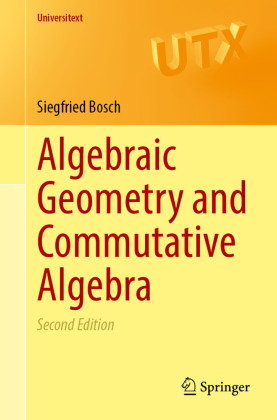
Algebraic Geometry is a fascinating branch of Mathematics that combines methods from both Algebra and Geometry. It transcends the limited scope of pure Algebra by means of geometric construction principles. Putting forward this idea, Grothendieck revolutionized Algebraic Geometry in the late 1950s by inventing schemes. Schemes now also play an important role in Algebraic Number Theory, a field that used to be far away from Geometry. The new point of view paved the way for spectacular progress, such as the proof of Fermat's Last Theorem by Wiles and Taylor.
This book explains the scheme-theoretic approach to Algebraic Geometry for non-experts, while more advanced readers can use it to broaden their view on the subject. A separate part presents the necessary prerequisites from Commutative Algebra, thereby providing an accessible and self-contained introduction to advanced Algebraic Geometry.
Every chapter of the book is preceded by a motivating introduction with an informal discussion of its contents and background. Typical examples, and an abundance of exercises illustrate each section. Therefore the book is an excellent companion for self-studying or for complementing skills that have already been acquired. It can just as well serve as a convenient source for (reading) course material and, in any case, as supplementary literature. The present edition is a critical revision of the earlier text.