






Diese Website verwendet Cookies und ähnliche Technologien. Dabei handelt es sich um kleine Textdateien, die auf eurem Computer gespeichert und ausgelesen werden. Indem ihr auf "Alles akzeptieren" klickt, stimmt ihr der Verarbeitung von Daten, der Erstellung und Verarbeitung von individuellen Nutzungsprofilen über Websites und über Partner und Geräte hinweg sowie der Übermittlung eurer Daten an Drittanbieter zu, die eure Daten teilweise in Ländern außerhalb der Europäischen Union verarbeiten (GDPR Art. 49). Einzelheiten hierzu findet ihr in den Datenschutzhinweisen. Die Daten werden für Analysen und für eigene Zwecke Dritter verwendet. Weitere Informationen, auch über die Datenverarbeitung durch Drittanbieter und die Möglichkeit des Widerrufs, findet ihr in den Einstellungen und in unseren Datenschutzhinweisen. Hier könnt ihr mit den notwendigen Tools fortfahren.
- Verlag: Oxford University Press
- Autor: Mark Williams
- Artikel-Nr.: KNV95629313
- ISBN: 9780198845874
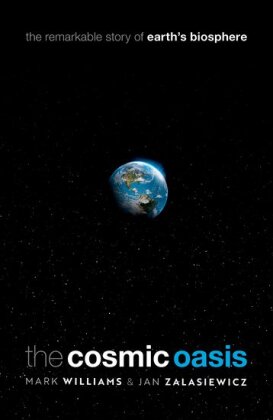
The Earth is a unique as a living planet, a cosmic oasis drifting in the vastness of barren space. It is strikingly and obviously different from our nearest heavenly neighbours, the Moon, Venus and Mars, in its thin skin of biology, extending from the surface for a few kilometres into the crust, and for a few tens of kilometres into the air. But how did this remarkable abundance and diversity of life arise? How has life survived over the enormous time frame of Earth's history? And does it continue to flourish now, especially with the growing pressure for space from humans?
The Cosmic Oasis examines life on Earth, from our earliest interactions with animals and plants to our absolute domination of biology. It follows our developing understanding of life's origins, its remarkable complexity, and its interactions with the air, oceans and land. It also shows how patterns of diversity across the surface of the planet evolved, and how humans are now homogenising these, degrading both biodiversity and the space in which life can exist. Within this overall trend of loss there are some remarkable examples of survival, from the beneficial relationships between the gelada monkeys and wolves of the Ethiopian highlands, and the people and brown howler monkeys of Porte Allegre in Brazil, to interactions between you and your gut microbiome. Thoughout, the authors ask what these interactions can teach us about building a better relationship with nature, and consider how we might become stewards, rather than destructive exploiters, of the life around us.