






Diese Website verwendet Cookies und ähnliche Technologien. Dabei handelt es sich um kleine Textdateien, die auf eurem Computer gespeichert und ausgelesen werden. Indem ihr auf "Alles akzeptieren" klickt, stimmt ihr der Verarbeitung von Daten, der Erstellung und Verarbeitung von individuellen Nutzungsprofilen über Websites und über Partner und Geräte hinweg sowie der Übermittlung eurer Daten an Drittanbieter zu, die eure Daten teilweise in Ländern außerhalb der Europäischen Union verarbeiten (GDPR Art. 49). Einzelheiten hierzu findet ihr in den Datenschutzhinweisen. Die Daten werden für Analysen und für eigene Zwecke Dritter verwendet. Weitere Informationen, auch über die Datenverarbeitung durch Drittanbieter und die Möglichkeit des Widerrufs, findet ihr in den Einstellungen und in unseren Datenschutzhinweisen. Hier könnt ihr mit den notwendigen Tools fortfahren.
- Verlag: Oxford University Press
- Autor: J.L. Heilbron
- Artikel-Nr.: KNV95629275
- ISBN: 9780192856654
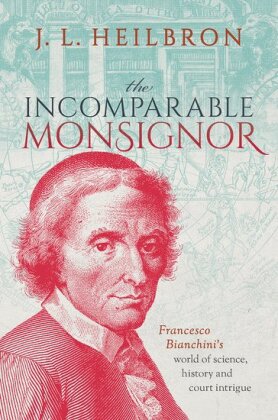
Born in a time where entry into the church granted power, privilege, and access to the most exciting ideas of his time, the magnificent Monsignor Francesco Bianchini was an accomplished player in the political, scientific, and historical arenas of early modern Europe. Among his accomplishments were writing a universal history from the creation to the fall of Assyria; discovering, excavating, and interpreting ancient buildings; and designing a papal collection of antiquities that was later partially realized in the Vatican museums. He was also responsible for confirming and publicizing Newton's theories of light and color; discovering several comets; and building the most beautiful and exact heliometer in the world in the basilica of Santa Maria degli Angeli in Rome.
Bianchini's international reputation earned him election to the Académie royale des sciences of Paris and the Royal Society of London. As a trusted servant of Pope Clement XI, he helped to execute the difficult balancing act the papacy practiced during the War of the Spanish Succession, which pitted Britain, the Dutch Republic, and the Habsburg Empire against France and Spain. One of his assignments also resulted in attachment to the cause and person of the Old Pretender, James III, the Stuart claimant to the thrones of England, Scotland, and Ireland. Through the career of this eminent and adept diplomat, astronomer, archaeologist, and historian, J. L. Heilbron introduces a world of learning and discovery, Church and State, and politics and power.