






Diese Website verwendet Cookies und ähnliche Technologien. Dabei handelt es sich um kleine Textdateien, die auf eurem Computer gespeichert und ausgelesen werden. Indem ihr auf "Alles akzeptieren" klickt, stimmt ihr der Verarbeitung von Daten, der Erstellung und Verarbeitung von individuellen Nutzungsprofilen über Websites und über Partner und Geräte hinweg sowie der Übermittlung eurer Daten an Drittanbieter zu, die eure Daten teilweise in Ländern außerhalb der Europäischen Union verarbeiten (GDPR Art. 49). Einzelheiten hierzu findet ihr in den Datenschutzhinweisen. Die Daten werden für Analysen und für eigene Zwecke Dritter verwendet. Weitere Informationen, auch über die Datenverarbeitung durch Drittanbieter und die Möglichkeit des Widerrufs, findet ihr in den Einstellungen und in unseren Datenschutzhinweisen. Hier könnt ihr mit den notwendigen Tools fortfahren.
- Verlag: Birkhäuser Berlin
- Autor: Dirk E. Hebel
- Artikel-Nr.: KNV95650567
- ISBN: 9783035621082
Sustainability is to become the guiding principle of social action and economic activity. At the same time, its ways and means are far from clear. As a holistic praxis, sustainability must combine technical and material as well as social, economic, ecological and also ethical strategies, which have multiple complex interactions and all too often also conflicting goals and priorities. In no other field can these be better observed, addressed and influenced than in architecture and building.
Each volume of "Building Better - Less - Different" details two fundamental areas of sustainability and explores their specific dynamics and interactions. After introductory overviews, innovative methods and current developments are described and analysed in in-depth essays, international case studies and pointed commentaries. The sustainability criteria of efficiency ("better"), sufficiency ("less") and consistency ("different") form the framework for each book.
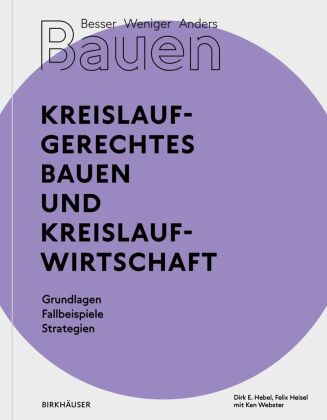
The first volume presents concepts, methods and examples of circularity in construction and the economy. Urban mining and circular construction are two approaches to the challenges that architecture and urban design are facing, using techniques such as mono-material construction and design for disassembly, and tools such as materials passports and databases. The circular economy is not solely about recycling but encompasses a wide range of strategies from local community projects to new ownership and service models and steering mechanisms such as carbon fees and dividends.