






Diese Website verwendet Cookies und ähnliche Technologien. Dabei handelt es sich um kleine Textdateien, die auf eurem Computer gespeichert und ausgelesen werden. Indem ihr auf "Alles akzeptieren" klickt, stimmt ihr der Verarbeitung von Daten, der Erstellung und Verarbeitung von individuellen Nutzungsprofilen über Websites und über Partner und Geräte hinweg sowie der Übermittlung eurer Daten an Drittanbieter zu, die eure Daten teilweise in Ländern außerhalb der Europäischen Union verarbeiten (GDPR Art. 49). Einzelheiten hierzu findet ihr in den Datenschutzhinweisen. Die Daten werden für Analysen und für eigene Zwecke Dritter verwendet. Weitere Informationen, auch über die Datenverarbeitung durch Drittanbieter und die Möglichkeit des Widerrufs, findet ihr in den Einstellungen und in unseren Datenschutzhinweisen. Hier könnt ihr mit den notwendigen Tools fortfahren.
- Verlag: Springer, Berlin
- Autor: Grivas Muchineripi Kayange
- Artikel-Nr.: KNV95660237
- ISBN: 9783030696474
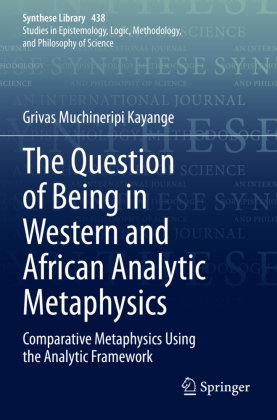
The main aim of this book is to discuss fundamental developments on the question of being in Western and African philosophy using analytic metaphysics as a framework. It starts with the two orthodox responses to the question of being, namely, the subject-verb-object language view and the rheomodic language view. In the first view, being is conceived through the analysis of language structure, where it is represented by subjects (particulars), objects, and relations (often universals). In the second view, there are different variations; however, the common idea is that the world's structure is revealed in the root verb of terms. This suggests a holistic and dynamic conception of being, where everything is in a continuous process of action. The book builds on analytic philosophy and explores metaphysical concepts such as space-time, modality, causation, indeterminism versus determinism, and mind and body. The book shows that in both Western and African thought, (i) similarities in different studies confirm that philosophy is a universal activity, (ii) differences within a context and beyond confirm the perspectival nature of human knowledge as individuals attempt to interpret reality, and (iii) language influences the conceptualization of being in a particular area. One of the novel aspects is the development of visual and mathematical African models of space and time.