






Diese Website verwendet Cookies und ähnliche Technologien. Dabei handelt es sich um kleine Textdateien, die auf eurem Computer gespeichert und ausgelesen werden. Indem ihr auf "Alles akzeptieren" klickt, stimmt ihr der Verarbeitung von Daten, der Erstellung und Verarbeitung von individuellen Nutzungsprofilen über Websites und über Partner und Geräte hinweg sowie der Übermittlung eurer Daten an Drittanbieter zu, die eure Daten teilweise in Ländern außerhalb der Europäischen Union verarbeiten (GDPR Art. 49). Einzelheiten hierzu findet ihr in den Datenschutzhinweisen. Die Daten werden für Analysen und für eigene Zwecke Dritter verwendet. Weitere Informationen, auch über die Datenverarbeitung durch Drittanbieter und die Möglichkeit des Widerrufs, findet ihr in den Einstellungen und in unseren Datenschutzhinweisen. Hier könnt ihr mit den notwendigen Tools fortfahren.
- Verlag: J.B. Metzler
- Autor: Christiane König
- Artikel-Nr.: KNV95710744
- ISBN: 9783476058874
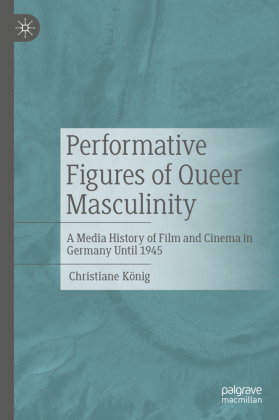
This is a German history of cinema and film from the 1890s to 1945 with a focus on queer masculinity. Using media studies approaches, the study shows how film as a new medium is constituted through performative re-enactments of spectacular elements from the entertainment and knowledge cultures of the 19th century. In it, bodies, desires and identities are constantly remodelled through the formation of difference. Therefore, male queerness here does not mean the representation of male homosexuality. Rather, it is the dynamic result of complex medial processes, affects and (self-)knowledge on and off the screen. Building on Eve K. Sedgwick's queer-feminist concept of queer performativity, the author creates a historically situated model with which she traces various figures of technically anthropomorphic queer masculinity in the medium of film in an empowering sense.
This book is a translation of an original German 1st edition Performative Figuren queerer Männlichkeit by Christiane König, published by J.B.Metzler, imprint of Springer-Verlag GmbH Germany, part of Springer Nature in 2020. The translation was done with the help of artificial intelligence (machine translation by the service DeepL.com). The author (with the friendly support of Megan Hanson) has subsequently revised the text further in an endeavour to refine the work stylistically. Springer Nature works continuously to further the development of tools for the production of books and on the related technologies to support authors.