






Diese Website verwendet Cookies und ähnliche Technologien. Dabei handelt es sich um kleine Textdateien, die auf eurem Computer gespeichert und ausgelesen werden. Indem ihr auf "Alles akzeptieren" klickt, stimmt ihr der Verarbeitung von Daten, der Erstellung und Verarbeitung von individuellen Nutzungsprofilen über Websites und über Partner und Geräte hinweg sowie der Übermittlung eurer Daten an Drittanbieter zu, die eure Daten teilweise in Ländern außerhalb der Europäischen Union verarbeiten (GDPR Art. 49). Einzelheiten hierzu findet ihr in den Datenschutzhinweisen. Die Daten werden für Analysen und für eigene Zwecke Dritter verwendet. Weitere Informationen, auch über die Datenverarbeitung durch Drittanbieter und die Möglichkeit des Widerrufs, findet ihr in den Einstellungen und in unseren Datenschutzhinweisen. Hier könnt ihr mit den notwendigen Tools fortfahren.
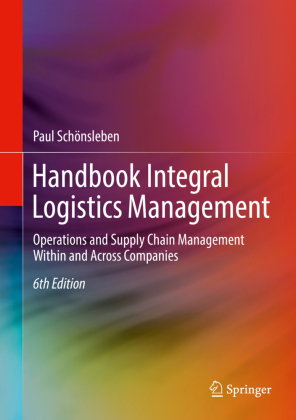
- Verlag: Springer, Berlin
- Autor: Paul Schönsleben
- Artikel-Nr.: KNV95943137
- ISBN: 9783662656242
This well-established handbook presents integral logistics management as the management of the flow of goods, data and control along the comprehensive life cycle of products and services in both classical and service industries. It offers a well-founded overview for managers, practitioners and advanced users. For the 6th edition, the content has been tightened and the following topics have been extended:
- the design of integrated offers of intangibles and tangibles goods in industrial product-service systems
- the integrated design of product, distribution, retail, service, and transportation networks for global location planning
- new examples of frameworks, standards and indices to practically demonstrate the social and environmental performance in sustainable in supply chains.
Other new sections deal with:
- the benefit of different types of cooperation between the R&D and engineering departments in companieswith an "engineer-to-order" (ETO) production environment
- the suitability of scenario planning for long-term demand forecasting, if influence factors of the surrounding systems play a role in an unknown manner.
Furthermore, each section now contains at the beginning its intended learning outcomes (ILO).
The material covers most of the key terms in the five APICS CPIM (Certified in Production and Inventory) modules as well as in the ASCM / APICS CSCP (Certified Supply Chain Professional) program.