






Diese Website verwendet Cookies und ähnliche Technologien. Dabei handelt es sich um kleine Textdateien, die auf eurem Computer gespeichert und ausgelesen werden. Indem ihr auf "Alles akzeptieren" klickt, stimmt ihr der Verarbeitung von Daten, der Erstellung und Verarbeitung von individuellen Nutzungsprofilen über Websites und über Partner und Geräte hinweg sowie der Übermittlung eurer Daten an Drittanbieter zu, die eure Daten teilweise in Ländern außerhalb der Europäischen Union verarbeiten (GDPR Art. 49). Einzelheiten hierzu findet ihr in den Datenschutzhinweisen. Die Daten werden für Analysen und für eigene Zwecke Dritter verwendet. Weitere Informationen, auch über die Datenverarbeitung durch Drittanbieter und die Möglichkeit des Widerrufs, findet ihr in den Einstellungen und in unseren Datenschutzhinweisen. Hier könnt ihr mit den notwendigen Tools fortfahren.
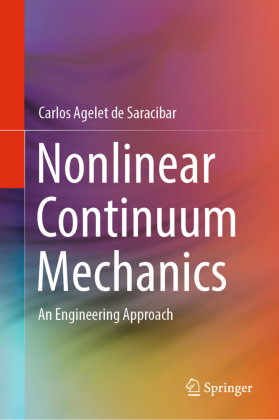
- Verlag: Springer, Berlin
- Autor: Carlos Agelet de Saracibar
- Artikel-Nr.: KNV96035853
- ISBN: 9783031152061
This textbook on Continuum Mechanics presents 9 chapters. Chapters 1 and 2 are devoted to Tensor Algebra and Tensor Analysis. Part I of the book includes the next 3 chapters. All the content here is valid for both solid and fluid materials. At the end of Part I, the reader should be able to set up in local spatial/material form, the fundamental governing equations and inequalities for a Continuum Mechanics problem. Part II of the book, Chapters 6 to 10, is devoted to presenting some nonlinear constitutive models for Nonlinear Solid Mechanics, including Finite Deformation Hyperelasticity, Finite Deformation Plasticity, Finite Deformation Coupled Thermoplasticity, and Finite Deformation Contact Mechanics. The constitutive equations are derived within a thermodynamically consistent framework. Finite deformation elastoplasticity models are based on a multiplicative decomposition of the deformation gradient and the notion of an intermediate configuration. Different formulations based on the intermediate configuration, the current or spatial configuration, and the material configuration are considered. The last chapter is devoted to Variational Methods in Solid Mechanics, a fundamental topic in Computational Mechanics. The book may be used as a textbook for an advanced Master's course on Nonlinear Continuum Mechanics for graduate students in Civil, Mechanical or Aerospace Engineering, Applied Mathematics, or Applied Physics, with an interest in Continuum Mechanics and Computational Mechanics.