






Diese Website verwendet Cookies und ähnliche Technologien. Dabei handelt es sich um kleine Textdateien, die auf eurem Computer gespeichert und ausgelesen werden. Indem ihr auf "Alles akzeptieren" klickt, stimmt ihr der Verarbeitung von Daten, der Erstellung und Verarbeitung von individuellen Nutzungsprofilen über Websites und über Partner und Geräte hinweg sowie der Übermittlung eurer Daten an Drittanbieter zu, die eure Daten teilweise in Ländern außerhalb der Europäischen Union verarbeiten (GDPR Art. 49). Einzelheiten hierzu findet ihr in den Datenschutzhinweisen. Die Daten werden für Analysen und für eigene Zwecke Dritter verwendet. Weitere Informationen, auch über die Datenverarbeitung durch Drittanbieter und die Möglichkeit des Widerrufs, findet ihr in den Einstellungen und in unseren Datenschutzhinweisen. Hier könnt ihr mit den notwendigen Tools fortfahren.
- Verlag: Springer, Berlin
- Autor: Robert D. Poodiack
- Artikel-Nr.: KNV96035694
- ISBN: 9783031137822
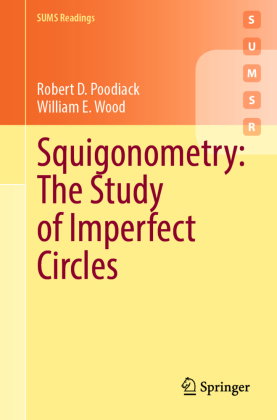
This textbook introduces generalized trigonometric functions through the exploration of imperfect circles: curves defined by |x|p + |y|p = 1 where p 1. Grounded in visualization and computations, this accessible, modern perspective encompasses new and old results, casting a fresh light on duality, special functions, geometric curves, and differential equations. Projects and opportunities for research abound, as we explore how similar (or different) the trigonometric and squigonometric worlds might be.
Comprised of many short chapters, the book begins with core definitions and techniques. Successive chapters cover inverse squigonometric functions, the many possible re-interpretations of pi, two deeper dives into parameterizing the squigonometric functions, and integration. Applications include a celebration of Piet Hein's work in design. From here, more technical pathways offer further exploration. Topicsinclude infinite series; hyperbolic, exponential, and logarithmic functions; metrics and norms; and lemniscatic and elliptic functions. Illuminating illustrations accompany the text throughout, along with historical anecdotes, engaging exercises, and wry humor.
Squigonometry: The Study of Imperfect Circles invites readers to extend familiar notions from trigonometry into a new setting. Ideal for an undergraduate reading course in mathematics or a senior capstone, this book offers scaffolding for active discovery. Knowledge of the trigonometric functions, single-variable calculus, and initial-value problems is assumed, while familiarity with multivariable calculus and linear algebra will allow additional insights into certain later material.