






Diese Website verwendet Cookies und ähnliche Technologien. Dabei handelt es sich um kleine Textdateien, die auf eurem Computer gespeichert und ausgelesen werden. Indem ihr auf "Alles akzeptieren" klickt, stimmt ihr der Verarbeitung von Daten, der Erstellung und Verarbeitung von individuellen Nutzungsprofilen über Websites und über Partner und Geräte hinweg sowie der Übermittlung eurer Daten an Drittanbieter zu, die eure Daten teilweise in Ländern außerhalb der Europäischen Union verarbeiten (GDPR Art. 49). Einzelheiten hierzu findet ihr in den Datenschutzhinweisen. Die Daten werden für Analysen und für eigene Zwecke Dritter verwendet. Weitere Informationen, auch über die Datenverarbeitung durch Drittanbieter und die Möglichkeit des Widerrufs, findet ihr in den Einstellungen und in unseren Datenschutzhinweisen. Hier könnt ihr mit den notwendigen Tools fortfahren.
- Verlag: Springer, Berlin
- Autor: Ajay Kumar Mishra
- Artikel-Nr.: KNV96157450
- ISBN: 9789811979774
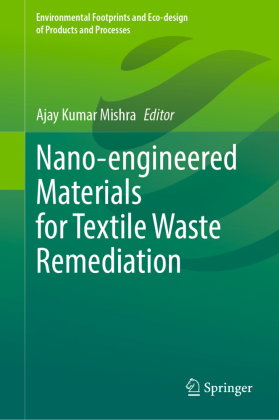
This book presents a complete state of the art for different types of nanomaterial, their environmental fate, and their use in textile waste remediation. Nano-engineered materials including nanoparticles, nanofibers, nanotubes have been used extensively for a variety of applications. Environmental concerns have been noted mainly due to the discharge of textile waste. Nanotechnology is fast growing on research and bringing sustainable solution in minimizing the waste. This also minimizes the risk of exposure and health hazards. With the development of industry, environmental pollution and energy shortage have raised awareness of a potential global crisis. So, it is urgent to develop a simple and effective method to address these current issues. Nano-engineered materials can be better solution in finding solution of environmental sustainability more specific to the textile waste remediation.
Nano-engineered materials have emerged as pioneering photocatalysts and account for most of the current research in this area. This can provide large surface areas, diverse morphologies, abundant surface states, and easy device modeling, all of which are properties beneficial to photodegradation. Furthermore, the stability and cost of nano-engineered materials are critical factors. Therefore, it is a challenge of great importance to identify and design nano-engineered materials that are efficient, stable, and abundant for the remediation of textile waste.