






Diese Website verwendet Cookies und ähnliche Technologien. Dabei handelt es sich um kleine Textdateien, die auf eurem Computer gespeichert und ausgelesen werden. Indem ihr auf "Alles akzeptieren" klickt, stimmt ihr der Verarbeitung von Daten, der Erstellung und Verarbeitung von individuellen Nutzungsprofilen über Websites und über Partner und Geräte hinweg sowie der Übermittlung eurer Daten an Drittanbieter zu, die eure Daten teilweise in Ländern außerhalb der Europäischen Union verarbeiten (GDPR Art. 49). Einzelheiten hierzu findet ihr in den Datenschutzhinweisen. Die Daten werden für Analysen und für eigene Zwecke Dritter verwendet. Weitere Informationen, auch über die Datenverarbeitung durch Drittanbieter und die Möglichkeit des Widerrufs, findet ihr in den Einstellungen und in unseren Datenschutzhinweisen. Hier könnt ihr mit den notwendigen Tools fortfahren.
- Verlag: Springer, Berlin
- Autor: Sarah Farrukh
- Artikel-Nr.: KNV96156780
- ISBN: 9783031214431
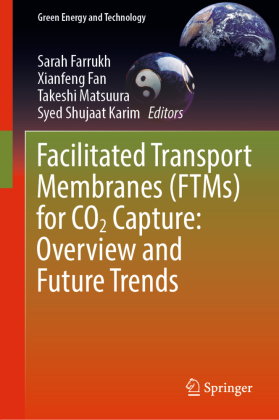
This book highlights the importance of Facilitated Transport Membranes (FTMs) for the application of carbon capture, covering its introduction, gas transport phenomena and models, reaction mechanisms, industrial applications such as bio-gas upgradation, flue gas separation, hydrogen gas and natural gas purification, fabrication methods of both FTMs and their carrier mediums, testing/characterization techniques, techno-analysis with up-to-date trends and the future outlooks. Climate change and environmental impacts are resulted due to greenhouse gases, particularly CO2. The industrial revolution is currently causing the augmented emission of greenhouse gases. Therefore, various technologies are being looked at to overcome these problems. In which, membrane technology is key among them and is envisaged for many industrial applications, especially for gas separations and carbon capture. Considering this, FTMs are being actively investigated due to their remarkable gas separation performance.
This book describes the working principle of FTMs and includes case studies to explore their impact on different industrial applications. Also, the book highlights how FTMs are reshaping science to capture CO2 for reducing climate and environmental impacts.