






Diese Website verwendet Cookies und ähnliche Technologien. Dabei handelt es sich um kleine Textdateien, die auf eurem Computer gespeichert und ausgelesen werden. Indem ihr auf "Alles akzeptieren" klickt, stimmt ihr der Verarbeitung von Daten, der Erstellung und Verarbeitung von individuellen Nutzungsprofilen über Websites und über Partner und Geräte hinweg sowie der Übermittlung eurer Daten an Drittanbieter zu, die eure Daten teilweise in Ländern außerhalb der Europäischen Union verarbeiten (GDPR Art. 49). Einzelheiten hierzu findet ihr in den Datenschutzhinweisen. Die Daten werden für Analysen und für eigene Zwecke Dritter verwendet. Weitere Informationen, auch über die Datenverarbeitung durch Drittanbieter und die Möglichkeit des Widerrufs, findet ihr in den Einstellungen und in unseren Datenschutzhinweisen. Hier könnt ihr mit den notwendigen Tools fortfahren.
- Verlag: Springer, Berlin
- Autor: Saeed Parsa
- Artikel-Nr.: KNV96158793
- ISBN: 9783031220562
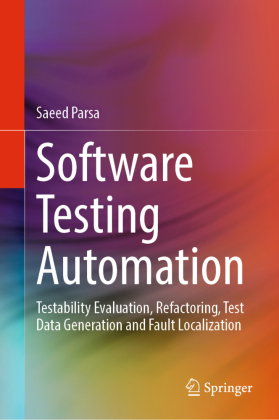
This book is about the design and development of tools for software testing. It intends to get the reader involved in software testing rather than simply memorizing the concepts. The source codes are downloadable from the book website. The book has three parts: software testability, fault localization, and test data generation.
Part I describes unit and acceptance tests and proposes a new method called testability-driven development (TsDD) in support of TDD and BDD. TsDD uses a machine learning model to measure testability before and after refactoring. The reader will learn how to develop the testability prediction model and write software tools for automatic refactoring.
Part II focuses on developing tools for automatic fault localization. This part shows the reader how to use a compiler generator to instrument source code, create control flow graphs, identify prime paths, and slice the source code. On top of these tools, a software tool, Diagnoser, is offered to facilitate experimenting with and developing new fault localization algorithms. Diagnoser takes a source code and its test suite as input and reports the coverage provided by the test cases and the suspiciousness score for each statement.Part III proposes using software testing as a prominent part of the cyber-physical system software to uncover and model unknown physical behaviors and the underlying physical rules. The reader will get insights into developing software tools to generate white box test data.