






Diese Website verwendet Cookies und ähnliche Technologien. Dabei handelt es sich um kleine Textdateien, die auf eurem Computer gespeichert und ausgelesen werden. Indem ihr auf "Alles akzeptieren" klickt, stimmt ihr der Verarbeitung von Daten, der Erstellung und Verarbeitung von individuellen Nutzungsprofilen über Websites und über Partner und Geräte hinweg sowie der Übermittlung eurer Daten an Drittanbieter zu, die eure Daten teilweise in Ländern außerhalb der Europäischen Union verarbeiten (GDPR Art. 49). Einzelheiten hierzu findet ihr in den Datenschutzhinweisen. Die Daten werden für Analysen und für eigene Zwecke Dritter verwendet. Weitere Informationen, auch über die Datenverarbeitung durch Drittanbieter und die Möglichkeit des Widerrufs, findet ihr in den Einstellungen und in unseren Datenschutzhinweisen. Hier könnt ihr mit den notwendigen Tools fortfahren.
- Verlag: Springer, Berlin
- Autor: Mohd Hafiz Arzmi
- Artikel-Nr.: KNV96192809
- ISBN: 9789811989360
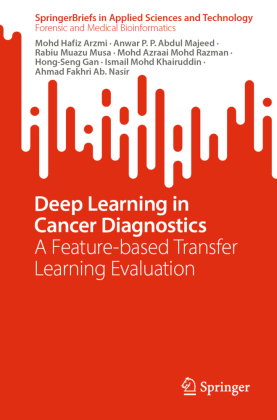
Cancer is the leading cause of mortality in most, if not all, countries around the globe. It is worth noting that the World Health Organisation (WHO) in 2019 estimated that cancer is the primary or secondary leading cause of death in 112 of 183 countries for individuals less than 70 years old, which is alarming. In addition, cancer affects socioeconomic development as well. The diagnostics of cancer are often carried out by medical experts through medical imaging; nevertheless, it is not without misdiagnosis owing to a myriad of reasons. With the advancement of technology and computing power, the use of state-of-the-art computational methods for the accurate diagnosis of cancer is no longer far-fetched. In this brief, the diagnosis of four types of common cancers, i.e., breast, lung, oral and skin, are evaluated with different state-of-the-art feature-based transfer learning models. It is expected that the findings in this book are insightful to various stakeholders in the diagnosis of cancer.