






Diese Website verwendet Cookies und ähnliche Technologien. Dabei handelt es sich um kleine Textdateien, die auf eurem Computer gespeichert und ausgelesen werden. Indem ihr auf "Alles akzeptieren" klickt, stimmt ihr der Verarbeitung von Daten, der Erstellung und Verarbeitung von individuellen Nutzungsprofilen über Websites und über Partner und Geräte hinweg sowie der Übermittlung eurer Daten an Drittanbieter zu, die eure Daten teilweise in Ländern außerhalb der Europäischen Union verarbeiten (GDPR Art. 49). Einzelheiten hierzu findet ihr in den Datenschutzhinweisen. Die Daten werden für Analysen und für eigene Zwecke Dritter verwendet. Weitere Informationen, auch über die Datenverarbeitung durch Drittanbieter und die Möglichkeit des Widerrufs, findet ihr in den Einstellungen und in unseren Datenschutzhinweisen. Hier könnt ihr mit den notwendigen Tools fortfahren.
- Verlag: Springer, Berlin
- Autor: Adnan Ibrahimbegovic
- Artikel-Nr.: KNV96201996
- ISBN: 9783031235917
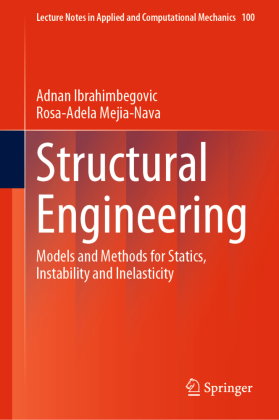
This book presents a novel approach to the classical scientific discipline of Structural Engineering, which is inspired by numerous current applications from domains of Civil, Mechanical or Aerospace Engineering. The main goal of this book is to help with making the best choice between accuracy and efficiency, when it comes to building the most suitable structural models by practising engineers using modern computational tools available in commercial software products (SAP, FEAP, ANSYS ...) for which we have carried out many developments that have been become the main reference in the field. Any development of this kind is not a mere modification of discrete approximation, but a thorough treatment with a sound theoretical formulation based upon Hu-Washizu variational principle with independent rotation field, its corresponding regularization and finally the most appropriate finite element interpolation that can match those used for structural elements. Proposed approach allows usto provide a unified discrete approximation of complex structural assemblies and greatly simplify the modeling task for structural engineers. Thus, in conclusion, this book can also be perceived as the theoretical manual for using modern computer models successfully by practising engineers.