






Diese Website verwendet Cookies und ähnliche Technologien. Dabei handelt es sich um kleine Textdateien, die auf eurem Computer gespeichert und ausgelesen werden. Indem ihr auf "Alles akzeptieren" klickt, stimmt ihr der Verarbeitung von Daten, der Erstellung und Verarbeitung von individuellen Nutzungsprofilen über Websites und über Partner und Geräte hinweg sowie der Übermittlung eurer Daten an Drittanbieter zu, die eure Daten teilweise in Ländern außerhalb der Europäischen Union verarbeiten (GDPR Art. 49). Einzelheiten hierzu findet ihr in den Datenschutzhinweisen. Die Daten werden für Analysen und für eigene Zwecke Dritter verwendet. Weitere Informationen, auch über die Datenverarbeitung durch Drittanbieter und die Möglichkeit des Widerrufs, findet ihr in den Einstellungen und in unseren Datenschutzhinweisen. Hier könnt ihr mit den notwendigen Tools fortfahren.
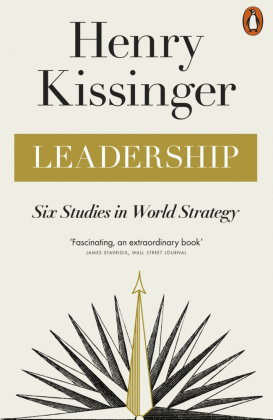
- Verlag: Penguin Books UK
- Autor: Henry Kissinger
- Artikel-Nr.: KNV96140617
- ISBN: 9780141998688
Henry Kissinger analyses how six extraordinary leaders he has known have shaped their countries and the world
'Leaders,' writes Henry Kissinger in this compelling book, 'think and act at the intersection of two axes: the first, between the past and the future; the second between the abiding values and aspirations of those they lead. They must balance what they know, which is necessarily drawn from the past, with what they intuit about the future, which is inherently conjectural and uncertain. It is this intuitive grasp of direction that enables leaders to set objectives and lay down a strategy.'
In Leadership, Kissinger analyses the lives of six extraordinary leaders through the distinctive strategies of statecraft which he believes they embodied. After the Second World War, Konrad Adenauer brought defeated and morally bankrupt Germany back into the community of nations by what Kissinger calls 'the strategy of humility'. Charles de Gaulle set France beside the victorious Allies and renewed its historic grandeur by 'the strategy of will'. During the Cold War, Richard Nixon gave geostrategic advantage to the United States by 'the strategy of equilibrium'. After twenty-five years of conflict, Anwar Sadat brought a vision of peace to the Middle East by a 'strategy of transcendence'. Against the odds, Lee Kwan Yew created a powerhouse city-state, Singapore, by 'the strategy of excellence'. Although when she came to power Britain was known as 'the sick man of Europe', Margaret Thatcher renewed her country's morale and international position by 'the strategy of conviction'.
To each of these studies, Kissinger brings historical perception, public experience and - because he knew each of their subjects, and participated in many of the events he describes - personal knowledge. The book is enriched by insights and judgements such as only he could make, and concludes with his reflections on world order and the indispensability of leadership today.