






Diese Website verwendet Cookies und ähnliche Technologien. Dabei handelt es sich um kleine Textdateien, die auf eurem Computer gespeichert und ausgelesen werden. Indem ihr auf "Alles akzeptieren" klickt, stimmt ihr der Verarbeitung von Daten, der Erstellung und Verarbeitung von individuellen Nutzungsprofilen über Websites und über Partner und Geräte hinweg sowie der Übermittlung eurer Daten an Drittanbieter zu, die eure Daten teilweise in Ländern außerhalb der Europäischen Union verarbeiten (GDPR Art. 49). Einzelheiten hierzu findet ihr in den Datenschutzhinweisen. Die Daten werden für Analysen und für eigene Zwecke Dritter verwendet. Weitere Informationen, auch über die Datenverarbeitung durch Drittanbieter und die Möglichkeit des Widerrufs, findet ihr in den Einstellungen und in unseren Datenschutzhinweisen. Hier könnt ihr mit den notwendigen Tools fortfahren.
- Verlag: Wiley & Sons
- Autor: Korin B. Hudson
- Artikel-Nr.: KNV96209645
- ISBN: 9781119266891
Clear, practical guidance in mastering ECG interpretation in the critically ill patient
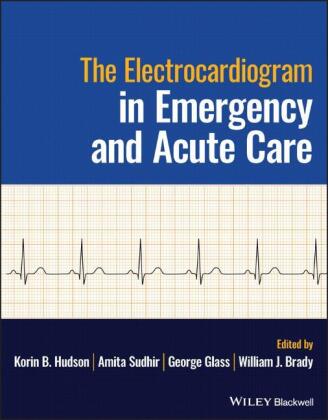
The Electrocardiogram in Emergency and Acute Care contains clear, practical guidance on mastering both single-lead and 12 lead ECGs, covering the full range of complexities and including a section on differential diagnosis of more common ECGs, with over 200 tracings from which to learn and self-test.
The editors place an emphasis on readability and accessibility, with clearly written chapters and excellent illustrations that serve as a primary source of information for students, trainees, and practicing emergency physicians in all areas.
In The Electrocardiogram in Emergency and Acute Care, readers can expect to find detailed information on topics such as:
* Clinical applications, impact, and interpretation of the electrocardiogram, plus variants of the normal, lead misplacement, and electrocardiographic artifact encountered in clinical practice
* Cardiac rhythms and cardiac dysrhythmias, covering cardiac rhythms with normal rates, narrow QRS complex tachycardia, wide QRS complex tachycardia, and bradycardia
* Anatomic and physiologic considerations of ischemic heart disease, historical development of the prehospital electrocardiogram, and electrocardiographic findings in acute coronary syndrome
* Special populations, high-risk presentation scenarios, and advanced electrocardiographic techniques, covering electrocardiograms in pediatric and poisoned patients
The Electrocardiogram in Emergency and Acute Care is ideally suited to medical students, residents, and physicians in training, but is also a useful reference for established physicians as a review and reference text, along with all other health professionals working in this field.