






Diese Website verwendet Cookies und ähnliche Technologien. Dabei handelt es sich um kleine Textdateien, die auf eurem Computer gespeichert und ausgelesen werden. Indem ihr auf "Alles akzeptieren" klickt, stimmt ihr der Verarbeitung von Daten, der Erstellung und Verarbeitung von individuellen Nutzungsprofilen über Websites und über Partner und Geräte hinweg sowie der Übermittlung eurer Daten an Drittanbieter zu, die eure Daten teilweise in Ländern außerhalb der Europäischen Union verarbeiten (GDPR Art. 49). Einzelheiten hierzu findet ihr in den Datenschutzhinweisen. Die Daten werden für Analysen und für eigene Zwecke Dritter verwendet. Weitere Informationen, auch über die Datenverarbeitung durch Drittanbieter und die Möglichkeit des Widerrufs, findet ihr in den Einstellungen und in unseren Datenschutzhinweisen. Hier könnt ihr mit den notwendigen Tools fortfahren.
- Verlag: Macmillan Publishers International
- Autor: Michael Burleigh
- Artikel-Nr.: KNV95915269
- ISBN: 9781529030174
'Written with Burleigh's characteristic brio, with pithy summaries of historical moments (he is brilliant on the Americans in Vietnam, for example) and full of surprising vignettes' - The Times 'Book of the Week'
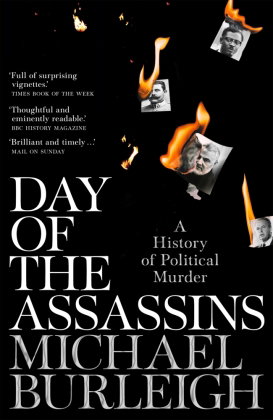
In Day of the Assassins, acclaimed historian Michael Burleigh examines assassination as a special category of political violence and asks whether, like a contagious disease, it can be catching.
Focusing chiefly on the last century and a half, Burleigh takes readers from Europe, Russia, Israel and the United States to the Congo, India, Iran, Laos, Rwanda, South Africa and Vietnam. And, as we travel, we revisit notable assassinations, among them Leon Trotsky, Hendrik Verwoerd, Juvénal Habyarimana, Indira Gandhi, Yitzhak Rabin and Jamal Khashoggi.
Combining human drama, questions of political morality and the sheer randomness of events, Day of the Assassins is a riveting insight into the politics of violence.
'Brilliant and timely . . . Our world today is as dangerous and mixed-up as it has ever been. Luckily we have Michael Burleigh to help us make sense of it.' - Mail on Sunday