






Diese Website verwendet Cookies und ähnliche Technologien. Dabei handelt es sich um kleine Textdateien, die auf eurem Computer gespeichert und ausgelesen werden. Indem ihr auf "Alles akzeptieren" klickt, stimmt ihr der Verarbeitung von Daten, der Erstellung und Verarbeitung von individuellen Nutzungsprofilen über Websites und über Partner und Geräte hinweg sowie der Übermittlung eurer Daten an Drittanbieter zu, die eure Daten teilweise in Ländern außerhalb der Europäischen Union verarbeiten (GDPR Art. 49). Einzelheiten hierzu findet ihr in den Datenschutzhinweisen. Die Daten werden für Analysen und für eigene Zwecke Dritter verwendet. Weitere Informationen, auch über die Datenverarbeitung durch Drittanbieter und die Möglichkeit des Widerrufs, findet ihr in den Einstellungen und in unseren Datenschutzhinweisen. Hier könnt ihr mit den notwendigen Tools fortfahren.
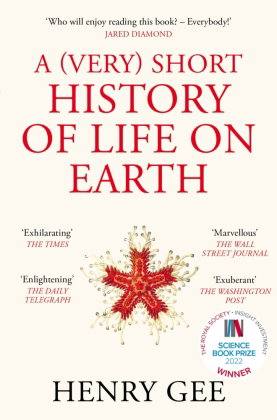
- Verlag: Macmillan Publishers International
- Autor: Henry Gee
- Artikel-Nr.: KNV95915278
- ISBN: 9781529060584
Winner of the Royal Society Science Book.
'Exhilaratingly whizzes through billions of years . . . Gee is a marvellously engaging writer' - The Times
4.6 billion years of the story of life on Earth, in twelve concise chapters. Brief, brilliant and entirely gripping.
For billions of years, Earth was an inhospitably alien place - covered with churning seas, slowly crafting its landscape through volcanic eruptions, the atmosphere in a constant state of chemical flux. And yet, despite facing literally every conceivable setback that living organisms could encounter, life has been extinguished and picked itself up to evolve again.
From that first foray to the spread of early hominids who later became Homo sapiens, life has persisted, undaunted. A (Very) Short History of Life: 4.6 Billion Years in 12 Chapters is an enlightening story of survival, of persistence, illuminating the delicate balance within which life has always existed, and continues to exist today. It is our planet like you've never seen it before.
Dr Henry Gee presents creatures from 'gregarious' bacteria populating the seas to duelling dinosaurs in the Triassic period, to magnificent mammals with the future in their grasp. Life's evolutionary steps - from the development of a digestive system to the awe of creatures taking to the skies in flight - are conveyed with an up-close intimacy.
'Henry Gee makes the kaleidoscopically changing canvas of life understandable and exciting.' - Jared Diamond, author of Guns, Germs, and Steel